
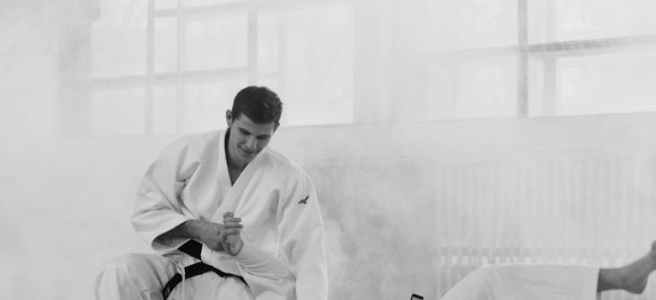
The following is an excerpt of an interview conducted for the newly released Takahiko Ishikawa: Judo’s Quiet Master, which recounts the life, times, and impact of Ishikawa on East Coast Judo in the United States. Howard Wray retells some of his memories training with Ishikawa and how he approached instruction.
Howard Wray found judo through a night school where Al Wallace was teaching. Wallace would take his students down to Philadelphia and introduce them to his instructor, Takahiko Ishikawa. From then on, Wray began to learn from both judo men. In this conversation in the summer of 2023, Wray recalls how Ishikawa structured his classes at the Ishikawa Judo Club.
MAYTT: What was the average training day like with Ishikawa?
HW: In the beginning of his classes, we would do breakfalls. We would do forward rolls. We would warm up. After we did all that – and if some kids needed help, he would help them – he would start teaching. He might start teaching, say, o goshi. And then, after a short period of time, he would teach us how to block o goshi. [Laughs] How to counter it. He would just keep on moving the class around it. I forget how long he actually taught for. And then, at the end, we always had randori. At the end of that, if we were really hot and bothered, we would have a cooling off period, where we would just sit and he would teach us how to breathe in and breathe out and concentrate. Then we would bow out and go home.
He used to teach standing techniques and he always taught some mat work. And in mat work, he would teach you how to do it and then he would teach you how to defend it. Then he would teach you how to move from one move to another move to compliment what you already had – if somebody did this, you’d do this. It was always a give and take. It was amazing. So, everything flowed, it didn’t stagnate. We just kept training, over and over again. We did an awful lot of uchi komi; an awful lot of randori. You learned from your mistakes. You learned how to defend and how to move your body, angle your body, and so forth. And you did it just by repetition until you got it down. I think it was just a good club.
The classes lasted for a good hour or so. Sometimes, after class, he would say to me, “Howard. Could you stay after class for a few minutes?” I would say yes, and after class, maybe ten of us would stay. And that was really something. That was usually on a Saturday. We’d stay for two minutes after class. What he would do is he would say, “You can’t go get water. You can’t do anything, but you have to stay on the mat for two minutes.” And, constantly, for two minutes, we exercised. We wormed our way, we had wheelbarrow races, we had to pull across the mat. First, it would be our arms, then it’ll be our stomachs, then our legs, and then we’d go back to our stomachs, then our legs; he would rotate it. After two minutes he would say, “Stop!” We’d bow out and we could go home. I remember the first time I did it, I almost couldn’t walk off the mat. [Laughs] It was that intense. I asked him: “Sensei. how did you do this when you were young?” he said, “I got up to ten minutes.” And the most I’ve ever got was up to three and a half or four minutes. I was shot after that. What he kept doing was working your system until you were totally exhausted. [Laughs] But we were in shape – there was no doubt about that.
MAYTT: What was one thing that stood out to you during his classes?
HW: On some Saturdays, Sensei would teach all the different katas. He taught the whole gambit of katas, and I can’t remember a quarter of them. [Laughs] I remember some of Katame no Kata, Ju no Kata, and Nage no Kata, because, to get my belt, I had to know Nage no Kata. Ju no Kata was for the women, and we had some women champions in that kata.
The other thing I remember distinctly in his classes would be that he would teach combination throws, say kouchi gari to ouhci gari, kouchi gari to osoto gari; we did combination moves all the time. We would attack and attack.
When Ishikawa taught, he was very flexible as a teacher. I didn’t find him strict at all. I never saw him get angry at any student, even the ones who did things not good. For example, we had a black belt who came in and he started hurting people. I remember one time, he wanted to randori with me. He was a bigger man than me. I was only five foot nine and I think at the time I only weighed about 135 pounds. Sensei told me not to randori with him. And the first person he came over to when it was time to randori was me and Sensei said no – that’s all he said. “You don’t randori.” He went off to somewhere else. And I don’t know why he was that way at all because most of the people that came to the club didn’t try to hurt people – you were there to learn, not to injure people.
Find out more about Wray, Ishikawa, and more in Takahiko Ishikawa: Judo’s Quiet Master!


 Martial Arts of Yesterday, Today and Tomorrow