
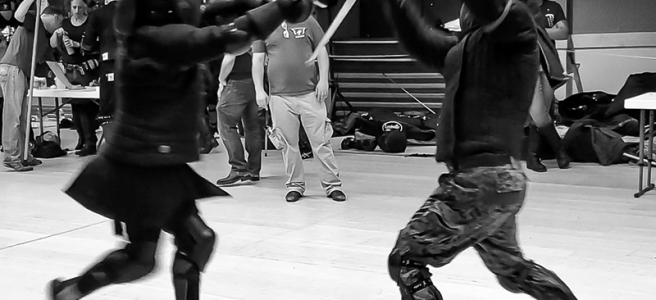
Josh Little began sword fighting when his high school physics teacher introduced LARP to him, which led Little to try out the Society for Creative Anachronism and Olympic Fencing. Later, in the late 1990s, he found historical fight manuscripts and never looked back. Around the same time, Little established his Ars Gladii, teaching a myriad of historical fencing systems. Using the skills he learned while in academia, Little approaches the manuscripts trying to place them in the time’s context. Today, Little took some time to talk about his extensive time in historical fencing, how the HEMA movement and community has evolved over the years, and what are some of the important aspects of historical fencing. All images provided by Josh Little et. al. This is the second part of a two part interview. Read the first part here.
MAYTT: It is interesting to think about it because a lot of the people that I have talked to have had the mindset of, “What do the sources say?” And it was not until recently where other historical fencers mentioned this living lineage or tradition that is occurring now in HEMA.

JL: That actually is cool. I can tell you that I’m fairly isolated and I’m not a social media guy. I do a little bit of traveling but I’ve been injured for about five years. But ever since the pandemic stuff happened, I haven’t really traveled much. I get the HEMA hive mind filtered in through my students and my instructors. “Oh, where did that come from?” “Oh, it’s from Facebook.” “Oh, I never heard of them.” That’s cool that it’s being talked about. We have to talk about it at a certain point. If we sit and say, “I’m not going to do something that’s not going to be in the manuscripts.” We’re not going to get very far. There’s always this debate, long ago, about frog DNA and I cannot remember the gentleman who brought up the whole concept of frog DNA into HEMA. This is the bringing in of other martial arts’ similar concepts to allow us to talk and explain things that are not contained in the sources that we do have. There was always this debate about how much do we allow, how much is too much, how much is being over-equivalent – that is similar to this and therefore here’s all this stuff from judo that we’re going to throw in here. Obviously, that is a risk and something that we don’t want to do because we may see similarities between two things. But I think there is a certain point where we’ve gotten this art to a far enough level that we’re not necessarily calling this frog DNA because we’re taking it from the experience of the people who are inside the what has now become its own tradition and using that as an internal feedback loop to create more things and raise and change understanding.
So, it’s not like we’re bringing things from outside that match on a superficial level; we’re actually now in that feedback loop internally that says, “I’ve tested it; I’ve done this, I’ve done that; I read it this way; what if it’s done this way; oh, that works. Oh, here’s why it works. This mechanic works with this. This is the same usage of leverage that we see here that is much more obvious than the descriptions of what we have, therefore this is similar to this; therefore, let me see what else I can try with this same understanding of leverage principles.” And then starting to build a systematic understanding inside of that, based upon our own experiences with the material. I think we have to do that.
With Liechtenauer tradition, we’ve got the bounty of riches – whatever you want to call it. We have a lot of manuscripts; some are fairly verbose, especially when you start talking about Johann Meyer. The Fiore manuscripts, he’s got probably less writings in those things than you do in Meyer’s preface to his work. So, we left ourselves only to what we had specifically stated in the source. Some of those traditions will actually be able to go very far, so, it has to be done. I think as long as you’re doing it correctly, it’s not a problem doing it. If you’re doing it from experience and you’re doing it from a core level of understanding – ability to keep out stuff that is superficial and keeping only that stuff that matches because it matches the tactical and the systematic approach that that work is doing, then that stuff becomes much more palatable to people.
MAYTT: The reverse of academics is competition; how much emphasis do you place on competition in your school?
JL: We have two kinds of tracks or separation between our students – it just happens naturally. We have probably a core of ten, give or take some, that are interested in traveling to tournaments, going to tournaments, working through that context. We’re primarily in a “If we want to get better at this; if I’m doing this to improve my understanding,” it’s part of that.
You can get to a certain point within your own school, but if you fence the same people, there’s a certain point where you’re going to ossify: the two of you will understand each other fairly well, you won’t see any additional styles, you won’t see any additional ways that people move, and it just kind of stagnates. A lot of it, what we are doing, is to combat that. Some of it is because it’s fun to travel around the country and fight people with swords. Tournaments are where you do that, so you might as well go do that. But we do have the course track that Sean Franklin runs for us; that’s our intensity course. The technical name is application of fundamentals at intensity, but we just call it intensity. That is essentially Sean’s take on putting basics together and doing it at a more and more intense level so that they become baked in.
Because he has a competitive sport with a kayaking background, he brings a lot of that kind of stuff into the school. He’s been doing a lot of work with games and using specific game types to teach and reinforce specific basics and specific motions and movements. So, we do a fair amount of stuff with games in various different classes, even in our normal classes, but that’s with more of the traditional types of techniques and weapons classes. We do a fair amount of just games that are there. It’ll be interesting; we’ll show up and there will be some sort of weird contraption and we know that Sean has some kind of game. Or I’ll show up on a certain night and there will be, now, new tape marks all over the floor, and, “Well. I gotta ask Sean what kind of new game he’s doing.” Because I’m almost certain that it’s from him.
That’s kind of the role that it plays in AG. We do a fair number of internal tournaments as well. Some of it’s the same social aspects of going to the regional or national tournaments. Because of the fact that we run five to six nights a week, the membership is now splintered. When we used to run – we are in our third year in our new place – the previous place where we were at, we were essentially there from Sundays from twelve to six, so we had six or seven hours straight of everyone’s here and doing stuff. We would have fifteen to twenty people showing at different times that Sunday. So, everybody saw each other there; everybody kind of knew each other. and now that we went to Tuesday, Wednesday, Thursday, some Fridays, Saturdays, and Sundays that have some kind of activity, not everybody all comes to all of that. So, we would have some of the students who were one to two years into the group that had never seen each other. So, we wanted to make sure people were coming so it’s not just a thing that people show up, do the thing, go home, and have no real connection or buy in to it.
Like every other HEMA school out there, we’re all volunteers and everybody pitches in and does what needs to be done. So, we are increasing that social cohesion between everybody keeps everybody invested, keeps people interested, and gives them reasons to be there even if they can’t. We’ve got several people that are out injured and things like that that are still around at the school and a lot for that is the school camaraderie that we put together. We just held our second one – we’ve had a few other ones, but we made this one almost a quarterly thing – where we have our internal tournaments where it’s open for every single person that’s a member of the school.

So, we’ve had some people that were actually still in our intro class that would like two or three classes and here they are in our internal tournament. We can move the goal posts for that kind of stuff, but we have them getting involved, getting to see people, and having fun with everybody and everybody’s hitting each other, and everybody’s laughing – just all kinds of crazy stuff is happening. So we use that for that, but it also gets some of those people in their early to mid-career that maybe have not gone to any outside tournaments, getting them into that environment to allow their fencing to be proven for them to see where it is that they are, both from a fencing standpoint and a personal engagement standpoint – what do they need to work on, what can they learn about themselves that they can work on? All the things we talk about like stress inoculation, getting people into a purposeful but stressful and safe situation so they can learn how to actually be there and learn that they can do their thing at that level.
That’s just not for fencing, that’s for everything else. If they can do that, can they go out and ask their boss for a raise, can they go propose to their partner; what other kinds of stressful things can they do now because they’ve gotten that ability to get past that and still perform. I like getting people into that situation. So doing tournaments internally where it’s just fun – our trophy was determined as we were giving it. We now have one of the Cold Steel polypropylenes, bash your friends swords. That’s now the internal tournament trophy and everybody gets to sign it when they win it. So now we just got this long record of people signing this stupid black plastic sword. And we have beer and pizza afterwards, but it’s a fun event.
One of Sean’s little inventions, we have a handicapped system for it, we do a lot of stuff with the foam GoNows because it allows people to get into the fun part of fencing faster instead of, “I’m going to hand you this plastic sword but you can’t swing it very fast and you can’t really stab anybody. Like in a year when you can afford all of your gear, you’ll get to have all the fun stuff. Well, here’s a big, padded sword and we know it’s not a sword. It doesn’t make all the fun stuff, but you get to hit your friend over there a lot.” “Okay! I wanna hit my friend!” [Laughs] So we got a ton of those that we use, especially during the summer when nobody wants to put on gear; “We’ll just hit each other with those things.”
We have the ability to take those guys and women that are three classes into an intro class and, “Here. Have a sword. Go figure out what works. Go fence that guy.” So, in the internal tournament, we essentially have a two-hour time limit; you fence as much as you want. And there’s a handicap – if the person you’re fencing has five more wins than you do, you start up five-zero and all you have to do is get to seven. I fought several of them where the handicap was six-zero; people just had to touch me and I lost the bout, which is also great for that whole stress inoculation for the really experienced people. How can I fence when I can only be hit once? I have to go all the way through the point structure against this person, but if they hit me once at all, I’m out. It’s a very interesting thing and I like what Sean put together with that format, so we’re using the heck out of that.
We use those competitions and that structure to help drive improvement in people. Going back to the context piece, that’s the context for HEMA. Yeah, you can go and play with swords, but the reason for what we’re doing here as a greater community is to start calling around and fencing each other, getting to these levels of competition, just like what was being done in the fifteenth/sixteenth century. They were doing this kind of stuff too. It looked different and they didn’t have fencing masks, but it was still what they were doing and how they contextualized their sport – how they contextualized their art. It wasn’t all – in fact, it probably wasn’t even much at all of stabbing somebody to kill – it was, let’s go play with swords and who’s better this time? And “I’ll get you next time. Now let go have some beer.” That’s how they participated in it and that’s how we should too.
MAYTT: That is really awesome how you are welcoming of beginners who only had two classes and you basically say, “Hey, you can hit people too.”
JL: So we’ve jimmied around with the whole how many days is it, what do we teach, where are teaching it, but pretty much what’s been consistent is that the last day of their intro class, the students get to hit each other with the foam swords and they get to have a sharp sword and get to cut a target with it. So, we’re handing them the swords: “Here. We’re going to explain to you how not to cut yourself, how not to cut other people, but here. Let’s try this. Let’s see what this stuff looks like now.” We used to do it on pool noodles and then we stopped being able to get the good pool noodles and we got these ones that unless you were absolutely perfect and just whizzed that sword, you weren’t cutting the thing. And we’ve also moved to hanging paper, which is an interesting cutting medium, which is actually great for intro people because it’s one hundred percent not about how fast you swing the sword and it’s all about how precisely you swing the sword. It’s an interesting cutting medium. It’s a cool thing that the guys can go through because they get to see more of the fun stuff about playing with swords – hitting people and using a sharp sword. Those are the fun things. You can watch sword on TV and read about it, but you gotta come to AG to hit people with it and cut stuff with a sharp one.
MAYTT: Who would you consider as instrumental or crucial to the modern HEMA revival movement in the United States?
JL: Oooo, that’s a big question. It’s going to change a lot depending on what era we’re talking about. At the very beginning, you’re going to have to talk about two people and both because they were the ones that started putting out some of the more accessible publications on it. That’s going to be – hate him or really hate him – John Clements and Christian Tobler. Both of those guys were some of the very first persons putting out publications for consumption as a secondary source for modern swordplay.
So, those guys kind of kickstarted some portions. Christian started the pushing forward and the pushing out of the Liechtenauer tradition with his Ringeck translation – this was way before Wiktenauer or anything like that. I mean, you even had people like Mike Rasmussen who, for a long time, had the only accessible Meyer translation before Dr. Jeffery Forgeng put his out, whenever that was [2016]. So, these were the kind of people that put that work into those original pieces to move them out.
You’ve got people like Greg Mele, who started Western Martial Arts Workshop, long ago, and how that used to bounce back between Chicago and Texas – between Chicago Swordplay Guild and Salle St. George down in Texas. So, you’ve got those people.
You’ve got Jake Norwood and the crew that started Longpoint – getting that out there. If it wasn’t for Longpoint, I don’t think you would get the New York Times article, which, at that point, starts a much broader ability to know that this was actually a thing. If we’re going to take this a little bit wider, you’ve got Christian and Natasha Darce who run Purpleheart Armory, who were around at the very beginning. I got some stuff from 1999/2000 from Purpleheart – a wooden waster and an old buckler. The buckler looks terrible but it’s been able to drink for years.

Without them being around. The early equipment isn’t out there. The reason why I got some many injuries is because we didn’t have equipment that protected ourselves. [Laughs] I didn’t wear gloves that actually protect my hands until probably 2016. I have so many microfractures in my hands, it’s not even funny. I think I went through a tournament in 2007 in Toronto with AEMMA where we were fencing with aluminum swords, because that’s what we used at the time. I was wearing cheap workman’s gloves with felt and butted chainmail over the top of them and those were my tournament gloves. I think it was a round robin tournament and we had twenty to twenty-tree people. I had my pinky, ring, and middle finger on my left hand were purple, going all the way down my arm. I probably had four broken fingers at the end of that thing. So, without that initial gear piece and the ability to get some of that stuff, HEMA would’ve had a harder time.
You got Michael Chidester who started up Wiktenauer, which allows that much more accessible, centralized data of being able to actually get into those sources. You got Jared Kirby and Doc Lennox who were the guys that started running ISMAC and later CombatCon, which has become a fairly large event these days. There’s a lot of those people out there that put things together. You got other people who published stuff, like Guy Windsor putting some stuff out on Fiore and fairly introductory books in there. a lot of people who were involved in more regional stuff.
MAYTT: How have you seen the HEMA community grow in the United States in the years you’ve been an active member?
JL: So, it’s hard to say. Those are some names that, especially from the early time frame of what started pushing the stuff through and farther out, and setting a foundation for the explosion that happened in the mid-2010s. I mean, I used to know pretty much every group in North America – knew either directly or at least through someone else, somebody that ran a club in North America. Now, I have absolutely no idea anymore. [Laughs] There are so many that I’m like, “I don’t know who that is.” It was funny when Sean came to us, when he moved to Michigan, he emailed and asked if he could come and see a practice. I didn’t know who he was. When I told my students, some of them asked, “Who’s coming?” “I don’t know. This guy Sean Franklin.” “Wait, the Blood and Iron YouTube Sean?” “I don’t know. I don’t watch YouTube. If you say so, sure.” [Laughs] At that point, I was like, “Whatever.” But he’s been a great addition. Absolutely great for our school.
At that point, it had already gotten to the point where I can’t keep track of everybody anymore. We’ve just now hit the critical mass where it stopped being a tight-knit community and now it’s just going into a larger, loose-knit community, which is both good and bad. It’s hard to really say that there’s a bad to it, outside of the fact that you can’t know everybody. But it’s more people involved. The fact that we have more people involved means that we have the ability to actually have commercial gear; we have things like Spes, Sparring Gloves, etc., and all the other manufacturers that by itself helps move the HEMA movement further along. It was difficult back in mid-2000. “Okay. I’d like my gear.” “Ok, well you need to find somebody to sew you a gambeson, and we’ll tell you about a couple of people but you’re going to have to send it away for it and you’ll get measurements over there, and maybe in a year it’ll show up. Here’s a fencing helmet at least.”
We had the choice, long ago, either wood, Del Tin Swords, or Arms and Armor – my first steel sword was from there when I bought it right from Craig Johnson at one of the ISMAC events. That was 2005 and I didn’t have anybody else use steel swords again for a while. We were mostly using aluminum stuff that came out of a company called Sword Crafts in Toronto. I didn’t mind that because when I was buying everything out of my own pocket, the Canadian dollar was sixty-eight cents to the American dollar, I was like, “I can buy two of these for the price of one!” [Laughs] But those were great swords for the time period. But nowadays, you have the choice of dozens of manufactures. I can actually send people to an actual webstore, and it’ll show up at your door. It’s no longer all bespoke, handmade gear. Outside of that, it’s having more people to play with – all great things that came form that explosion that did away with that very niche community feeling and made it into something bigger.
MAYTT: Where do you think HEMA will grow in the United States in the next decade or so?
JL: Where do we go from here? I think we’re going to get to a certain point – it’s already getting interesting now. I spoke about the expansion of HEMA and how it’s growing out and we’re getting to this point where it’s nearly impossible to schedule events any longer with the expectation now we’re not going to step on somebody else’s thing. It was already starting to get harder last year; it’s going to get harder even more. As more and more groups come up and more and more events start populating, we’re either going to get to a point where we start to regionalize a little bit more and things get scheduled on a region by region basis, which I already start seeing happen, or we’re going to consolidate into a couple large national events and then regionalize for some of the more things. That’s just from a community standpoint.
We are even starting to find it hard in Michigan and the Great Lakes Regions as we are starting to get groups that are starting to want to do their own events and finding space in the calendar to actually get those things in there. So that’s both a good problem and a bad problem. We already had that break from a close-knit niche community to now with a niche loose-knit community. Now we’re going to start to fracture a bit more just because of the fact that – online’s great – being in person and actually interacting with them, just from a human level, is the only way we keep some of this stuff going. And as people break apart more and more, which events can I go to? There are only so many. “Do I really need to travel to California for this event when I have four more here in my backyard?” So, I think we’re going to have to work out how that is going to work out. I think some events will pop up, go on for a couple of years, and go away. As somebody who is not even one of the main organizers of our tournament, it was a butt ton of work just to get it going. So, we’ll see what happens with that. That’ll be interesting.
I think we’ll continue to see the pop up of some of the smaller, regional groups. I think we’re also at that point now where enough people have had enough ability to train under one group, move, and then start their own group, which is a difference than say the late 2000s to the mid-2010s, where if you were in a non-served region, you were like, “Well, I’m going to start a group. We’ll play around with some stuff on YouTube and then we’re going to play away.” Having to start all over from scratch, where now we’re going to start seeing – and we are already seeing this, but I think it’s going to continue – groups develop in these new areas that are started by people who already have a background. We’ll see how this works out but go back to that idea of living tradition and see those differences in the way people take this static piece – because manuscript is static, it doesn’t change – and see how that interpretation grows and lives. It will be interesting to see, assuming that we’re doing this in twenty-five years, if we can trace those now starting to become living traditions through these people and seeing how that stuff changes.

We already see it with regionalization and the fact that you’ll hear people talk, “Oh, well, the South are aggressive fighters. They hit hard.” And all this kind of stuff. While the people up here are doing this and the people over there and doing this. And now you start to see it on almost “lineage” level where ideas that started with one group pass and move through other groups and are built upon and seeing how it works out for different ones and being able if we can see significant differences between those things and see if we can trace those things back to how each of those groups is founded, who taught HEMA here, who moved where, that kind of stuff. That would be an interesting HEMA historical project in 2055 or whatnot if we’re still mulling around and still doing this kind of stuff, or we all got bored, we all got broken, or no one will insure us anymore. [Laughs]
That will be the interesting thing. We are still at that point where we are still a fragile community. If we lose the ability to get insurance, that starts to break us. If we start losing these manufacturers, what happens if Spes goes away? We’re in a pretty good peak golden age; maybe we’ll get another golden age after that, or maybe we’ll get a dark age after this because some of our support structures start to go away. I think we’re in that thing where, “Things are great, and it’ll always keep being great.” And then we realize that there are a couple of rotted support structures underneath here and if those fall away, what happens to us? Not to be all doom and gloomy at the end of the interview [Laughs] But some of that’s on my mind since I have to deal with this insurance crap for the last week. But we’ll persevere but it’ll be interesting to see. We’re in a really good spot but we have a little bit of shaky legs and it’ll be real interesting to see what comes out of this from now.
One of the things that I see a lot, especially in the last five to eight years and some of this has been driven because now we have the gear, is the level of fencing, both in terms of speed, intensity, and technique and precision, has gone way up, probably in the last five to eight years. That will be interesting to see where that continues to go. That’s cool because I was not a big proponent of tournaments in the early 2010s because you look at the fencing and it was terrible – this is just bad. It was not what you practiced in the hall versus what you fenced with in the tournament – they were not at all the same. One looked ok and the other looked like an absolute dog’s dinner. That has gone away, except for sword and buckler tournaments. I love sword and buckler – it’s my favorite thing to play – but their tournaments are still meh. It amazes me that sword and buckler tournaments are the ones where all the injuries happen.
The quality of fencing, the ability of people to execute solid technique-driven principles-driven fencing; I’m not talking about, “Oh, that’s play number thirty-seven from this manuscript;” it’s them actually fencing and following the principles, you can see what they’re doing, you can see what they’re looking to do, seeing how they execute it and execute it with precision. The technicality of fencing has gone way up, which is great because that means that training is actually going in the right direction. We’re not just seeing people perform well because they’re athletic and out-raw talent other people, though you’ll still see that. You’re seeing people internalize fencing and principles and execute them at high levels of precision, at speed, and high levels of stress. That’s when you can see that training methodologies and understanding has gotten to a specific level. And that’s really exciting to see.
MAYTT: Thank you again for joining us today! It was a very insightful conversation.
JL: Thank you for having me.
This is the second part of a two part interview. Read the first part here.


 Martial Arts of Yesterday, Today and Tomorrow