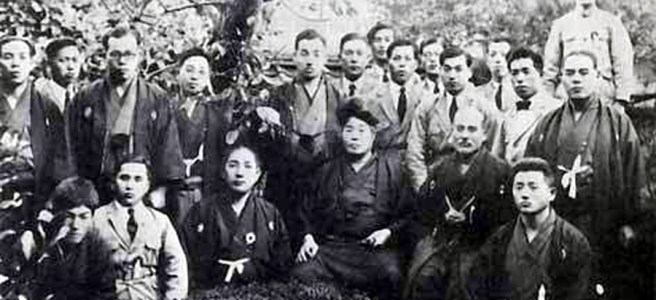
In the early 20th century, martial arts were viewed primarily as practical tools for self-defense or military applications. However, Onisaburo Deguchi, the charismatic leader of the Omoto-kyo spiritual movement, recognized that martial arts could serve as much more than that – a tool to cultivate spiritual awareness. He understood that martial arts, such as Daito-ryu Aiki-jujutsu, held within them the potential to transcend physicality and become a spiritual practice aligned with Omoto-kyo’s ideals.
In Omoto-ryu Kami-jutsu, Deguchi realized the opportunity to create a martial art system that was not merely a form of self-defense, but a ritualized practice that aligned the practitioner’s mind, body, and spirit with the divine forces of the universe. Omoto-ryu Kami-jutsu, in this sense, would guide practitioners toward spiritual harmony and a deeper understanding of Omoto-kyo’s core principles. Thus, Omoto-ryu can become a bridge between the material world (martial arts as physical practice) and the spiritual world (Omoto-kyo as a religious and philosophical system). It would give Omoto-kyo followers a unique avenue to deepen their faith while also engaging with martial arts at a high level.
Deguchi had hoped that one of his followers, Morihei Ueshiba, who was already a master of Daito-ryu Aiki-jujutsu, would bring this transformation to fruition. However, Ueshiba simply taught his version of Daityo-ryu Aikijutsu without embedding any Omoto-kyo principles or concepts. After Uesbiba left Ayabe for Tokyo in 1927, some of his senior Daito-ryu students undertook this task of integrating the physicality of Daito-ryu Aikijutsu with the spirituality of Omoto-kyo.
That vision faced annihilation in December 1935, when the Japanese government violently suppressed Omoto-kyo. Temples were destroyed, texts burned, and over 3,000 adherents – including Deguchi – were imprisoned. Yet the spirit of Omoto-ryu Kami-jutsu did not vanish. It went underground – literally – into the forested mountains of the Kii Peninsula.
A number of Omoto-ryu Kami-jutsu practitioners fled Ayabe and found their way to remote areas of the Kii Peninsula, where they continued their practice. There, they farmed the land in spiritual harmony with the kami and practiced Omoto-ryu Kami-jutsu as an integral part of their Omoto-kyo life. This rugged terrain provided the perfect setting for aligning themselves with the kami. Training sessions took place in open fields, beside rivers, in snow, and in summer heat. These were not inconveniences – they were forms of misogi, helping purify body and mind to facilitate deeper spiritual alignment. The mountains not only protected them, but more than that, they connected them more intimately with the kami. This simple, ascetic life continues to this day among Omoto-ryu Kami-jutsu practitioners in Kii, who maintain the tradition as a living embodiment of their faith and martial path.
Here, in the quiet isolation of the Kii Peninsula, Omoto-ryu Kami-jutsu practitioners did more than preserve the art—they deepened it into a sacred discipline in which martial technique and spiritual devotion became inseparable. This spiritual connection between the practitioner and the kami became the heart of Omoto-ryu Kami-jutsu – a living manifestation of the universal divine principles taught by Omoto-kyo. Every movement became an expression of universal harmony, and martial practice served as a direct channel to spiritual awakening.
By synthesizing the teachings of Daito-ryu and Omoto-kyo, Omoto-ryu Kami-jutsu became a unique and holistic martial art system that also serves as a spiritual path – one that transcends physical techniques and aims for divine alignment and harmonious existence. The core principles of Daito-ryu provided the foundational tools in the transformation of it into the far more spiritually charged Omoto-ryu Kami-jutsu.
Aiki (Blending)
In traditional Daito-ryu, the principle of aiki is about blending with an opponent’s energy rather than confronting it head-on and guiding them into a controlled fall or lock. However, in Omoto-ryu Kami-jutsu, this blending of energy is seen as a metaphor for blending with divine will. Every movement, from joint locks and throws to strikes, serves to redirect the opponent’s energy into spiritual alignment with the divine.
Kuzushi (Balance Breaking)
Daito-ryu techniques focus on destabilizing the opponent’s posture and balance, making them vulnerable to locks, throws, and strikes. In Omoto-ryu Kami-jutsu, kuzushi transcends its purely physical meaning and takes on a spiritual dimension. Instead of simply using force to break the opponent’s posture, the practitioner breaks their spiritual balance. The practitioner does not physically harm the opponent, but guides them through a spiritual shift. This involves reading the opponent’s emotional or energetic state—noticing their intent, anger, or aggression – and redirecting that energy into a spiritual alignment with the divine.
Tai Sabaki (Body Movement)
The focus on tai sabaki in Daito-ryu is primarily on practical applications, such as evading attacks, maintaining balance, and creating advantageous angles for joint locks, throws, or strikes by blending with an opponent’s force, guiding them into positions of unbalance or immobility. In contrast, Omoto-ryu Kami-jutsu transforms the concept of tai sabaki from a combat technique into a spiritual practice. While the basic body movements still involve evading or redirecting the opponent’s force, the key difference lies in the intention and purpose behind the movement. In Omoto-ryu Kami-jutsu, tai sabaki is no longer just a physical strategy for evading or countering attacks; it becomes a means of spiritual alignment with the divine.
These core principles made Daito-ryu an exceptionally effective martial art and formed the physical bedrock of Omoto-ryu Kami-jutsu. Omoto-ryu Kami-jutsu sought not only to defeat opponents, but to transform conflict into harmony, seeing martial arts as a means of spiritual purification and alignment rather than as a tool for physical confrontation.
Omoto-kyo itself emphasizes spiritual enlightenment, divine unity, and the cultivation of divine virtues through everyday life. This focus profoundly altered the martial art application of Daito-ryu techniques. Omoto-kyo’s influence reframed Daito-ryu’s combat techniques as not just a means of self-defense, but as expressions of divine will and tools for spiritual cultivation. Combat would no longer be about defeating an opponent, but about redirecting the opponent’s energy in alignment with the divine order of the universe. The central aim is achieving spiritual harmony through martial art practice.
By integrating the technical principles of Daito-ryu with the spiritual ideals of Omoto-kyo, a martial art system was created that transcends traditional combat arts. This new system, Omoto-ryu Kami-jutsu, retained the core techniques of Daito-ryu, but it redefined them as spiritual expressions aligned with divine harmony.
Shinto, Japan’s indigenous religion, is centered around the worship of kami – spirits or gods – that inhabit all aspects of the natural world. Everything from trees, rivers, and mountains, to animals and even human beings is believed to be imbued with a spiritual essence. Kami are not just distant divine beings; they are present in the world and in every moment of life.
Omoto-ryu Kami-jutsu incorporates this deeply animistic worldview where the martial art techniques themselves – whether joint locks, throws, or strikes – are considered expressions of divine will and forms of a sacred engagement with these spiritual forces that guide the universe. Techniques are understood as channels through which the practitioner aligns their own energy with the divine. The movements of the body, the techniques of joint locks, throws, and even strikes are considered spiritual acts that reflect the cosmic flow of divine energy. The practitioner’s movements mirror the natural rhythms of the universe, just as the kami dance in the natural world. This would create a holistic experience of body, mind, and spirit working in unison with the divine. Every action in Omoto-ryu Kami-jutsu must be performed with reverence for the kami and as an offering to the kami, an embodiment of spiritual harmony in motion. Rather than relying on strength or violence, each movement is a blending and flowing with the divine energy that connects all things.
In Omoto-ryu Kami-jutsu, the techniques inherited from Daito-ryu Aiki-jujutsu underwent a profound transformation, evolving from practical self-defense into a spiritual practice. The same joint locks, throws, and strikes that were used for defense in Daito-ryu take on divine meaning – not as tools of violence, but as means to align with divine order and foster peace.
Joint Locks
In Daito-ryu, joint locks are used to cause pain compliance or immobilize an opponent. In contrast, the aim in Omoto-ryu Kami-jutsu is to harmonize the opponent’s force with the divine flow, guiding them to a spiritual alignment without causing injury. Locks are applied gently, maintaining a connection to the opponent’s energy and redirecting it toward peaceful resolution. Rather than a painful submission, it represents an opportunity for spiritual awakening, where the opponent is not harmed, but guided to find inner harmony.
Throws
In Daito-ryu, throwing techniques are essential to subduing the opponent. However, in Omoto-ryu Kami-jutsu, throws are carried out with a spiritual intention to liberate not only the opponent, but also the practitioner as well. Throws are smooth and fluid, aligning both the practitioner and the opponent with the natural world and the forces of the kami. The throw is not about using strength or brutality, but about using spiritual sensitivity and the ability to blend with the opponent’s energy. When an opponent is thrown, it symbolizes their release from aggression and an opportunity for them to connect with a deeper, more peaceful state of mind.
Strikes
In traditional Daito-ryu, strikes are used to attack vital points on the body to physically and mentally unbalance an opponent for follow-up locks or throws, or to incapacitate them. In Omoto-ryu Kami-jutsu, strikes are not aimed at harming or incapacitating the opponent, but serve to disrupt the opponent’s spiritual imbalance rather than their physical body. The strike represented a moment of awakening for the opponent, a jolt that redirected their focus from aggression to spiritual clarity. Thus, atemi is a way to use minimal force to control the opponent, not with violence, but with precision and spiritual alignment.
A profound spiritual and philosophical journey unfolds for practitioners through Omoto-ryu Kami-jutsu as they move from duality to unity and ultimately align with the divine energy that pervades the universe. The roles of Tori (the defender) and Uke (the attacker) evolve throughout the practitioners’ journey, progressing from seemingly separate, opposing forces to a seamless, divine collaboration that reflects the interconnectedness of all things.
The core of Omoto-ryu Kami-jutsu is the pursuit of harmony – not just in martial art practice, but within oneself, with others, and with the universe. At the heart of this practice lies the realization that duality – such as attacker and defender, or strong and weak – while essential at the beginning, is ultimately an illusion to be transcended. This journey toward oneness mirrors the overarching spiritual goal of Omoto-kyo, where practitioners are encouraged to recognize their oneness with the divine, with all living beings, and with the very fabric of existence.
The Initial Duality: Tori and Uke as Opposites
At the outset of training, the roles of Tori and Uke appear clearly defined and separate. Tori, the defender, must respond to the force of Uke, the opponent, with specific techniques designed to redirect, neutralize, or blend with the incoming energy. This phase reflects the dualistic nature of the world – active versus passive, attacker versus defender, and strong versus weak. Tori’s role is reactive, working against the energy of Uke by either controlling or deflecting it.
On the surface, the relationship between Tori and Uke seems adversarial, a direct confrontation of opposing forces. This view of martial arts’ interaction emphasizes the physical and combative aspects of the practice. Yet, even in this initial stage, there is an implicit recognition within Omoto-ryu Kami-jutsu that these roles are not fundamentally separate, but are two sides of the same coin. This understanding hints at a deeper, more spiritual truth: that the true purpose of martial arts’ engagement is not to destroy or defeat the opponent, but to transform conflict into inner harmony and divine alignment.
This dualistic stage is merely the starting point. The real aim of Omoto-ryu Kami-jutsu lies in transcending this opposition and moving toward a state of unity between the two forces. As practitioners progress in their understanding of the art, they begin to see that Tori and Uke are not isolated, separate entities. Instead, they are interconnected, and their roles complement each other within a larger, divine flow of energy.
The Emerging Harmony: Moving Beyond Duality
As practitioners advance, their understanding deepens. The roles of Tori and Uke begin to shift from adversarial to cooperative. In the next phase of development, Tori and Uke begin to blend their energies rather than oppose them. The concept of “coupling” – the merging of Tori’s and Uke’s actions – becomes the focal point of training. Rather than treating Uke as an opponent to be overcome, Tori starts to view Uke as a necessary partner in the unfolding of the technique. Each participant is no longer working against the other, but is engaged in a mutual process of co-creation.
This transition is an essential aspect of the spiritual teachings of Omoto-kyo, which emphasize the interconnectedness of all things. The divine flow of ki runs through both Tori and Uke, and it is through this shared energy that they are able to create harmonious movement together. The roles of Tori and Uke start to blur, and their actions become complementary. The separation between them dissolves as they begin to work in unison, in harmony with the universe.
The process of coupling in Omoto-ryu Kami-jutsu mirrors the larger spiritual journey of Omoto-kyo, which emphasizes the understanding that all beings and all forces are interdependent. As Tori and Uke blend their energies and harmonize their movements, they are not just executing a martial art technique; they are engaging in a spiritual practice that reflects the universal order. The technique, once seen as a means of defense or victory, becomes an expression of the divine harmony that underlies all existence.
At this stage, practitioners begin to perceive that Tori and Uke are not separate in the sense they once appeared to be. Their relationship is one of mutual support, mutual creation, and divine alignment. The very act of blending their energies through the techniques represents a sacred dance of the universe’s opposing forces – forces that, when harmonized, reveal their essential oneness.
A Unified State: The Ultimate Realization of Oneness
As practitioners reach the highest levels of Omoto-ryu Kami-jutsu, the distinction between Tori and Uke is fully transcended. The once-separate roles merge into a single, unified state of being. The duality of attacker and defender, of passive and active, disappears entirely. At this stage, both Tori and Uke move as a single entity, their actions guided by the same divine will. The line between them has been erased, and they are no longer two participants in a martial art engagement, but are one in physical action and spirit.
This ultimate state of unification is not simply a physical synchronization of movements, but a profound spiritual union. The movements of Tori and Uke now reflect the divine will, demonstrating the deep interconnectedness of all things. Omoto-ryu Kami-jutsu becomes less about the techniques themselves and more about the expression of divine unity through those techniques. This is where the martial art transforms from a form of self-defense into a spiritual discipline, where the practice reflects the oneness of the practitioner with the universe.
At this advanced stage, Omoto-ryu Kami-jutsu becomes a spiritual path – an embodiment of the divine flow and a means for the practitioner to align with the universal energy that connects all things. True victory, therefore, is no longer found in overcoming an opponent, but in the realization of unity – with one’s self, with one’s partner, and with the divine.
Inner Harmony: The Path to External Unity
Before achieving this external harmony with one another, however, both Tori and Uke must first achieve harmony within themselves. The process of unifying with the other requires a deep understanding of one’s own inner world – a complete surrender of the ego, allowing the individual will to dissolve in favor of the greater divine will that governs both the martial art and the universe. In Omoto-ryu Kami-jutsu, this inner harmony is rooted in self-mastery, not just over the body, but also over the mind and spirit.
For Tori to harmonize with Uke, they must first harmonize with themselves, as separate egos cannot be blended. This requires a complete surrender of the ego, allowing the individual will to dissolve in favor of the greater divine will. Inner harmony is cultivated through practices like meditation, the development of ki, and spiritual purification. These practices help the practitioner align with the universal flow of energy, fostering balance, peace, and a deep connection with the divine.
Only when both Tori and Uke have achieved this internal harmony can they truly harmonize with one another and, by extension, with the universe itself. The movements they perform together, when in perfect alignment, reflect the natural flow of cosmic energy – manifesting the oneness of all things.
The Ultimate Expression of Divine Flow
The journey from duality to oneness – from separation to harmonization – represented by the roles of Tori and Uke in Omoto-ryu Kami-jutsu – is a reflection of the core spiritual teachings of Omoto-kyo. Through the transformation of the roles of Tori and Uke, from adversaries to partners, the practitioner learns not just martial art techniques, but also the profound spiritual lesson of interconnectedness.
This unity within Omoto-ryu Kami-jutsu reflects the core spiritual teaching of Omoto-kyo: the belief that the divine is present in all things and that by aligning with the divine order, harmony and peace are brought about in the world. The ultimate aim of Omoto-ryu Kami-jutsu is to transcend the duality between Tori and Uke, recognizing that all beings, all forces, and all things are part of the same divine energy, and that through harmonizing with each other, they harmonize with the divine itself.
Omoto-ryu Kami-jutsu is structured not just as a progression of physical skills, but as a phased path that offers practitioners a complete system that integrates both physical techniques and spiritual discipline.
Shoden (Beginner’s Path)
In the early stages of training, practitioners learn the basic techniques of the art – joint locks, throws, and strikes. During this phase, the focus is also on cultivating an awareness of ki and aligning oneself with the divine. Purification practices (misogi) are introduced to prepare the practitioner’s body and mind to become spiritually aligned with the kami and the divine. Shoden practitioners are encouraged to meditate on the kami and reflect on their spiritual journey. At the beginning of each session, practitioners call upon the kami, offering prayers and gratitude for the spiritual guidance that enables their practice. This phase serves as a foundation for both physical and spiritual growth, where the practitioner learns to harmonize with the flow of divine energy.
Chuden (Middle Path)
As practitioners progress, they begin to refine their understanding of ki, deepening their connection with the natural world and the kami. Chuden practitioners focus on the subtler aspects of techniques, learning how to blend with their opponents’ energy rather than forcefully overcoming them. They are taught to think of every technique as a form of spiritual expression – a divine act that transforms aggression into inner harmony and spiritual alignment. Training also involves more elaborate ceremonies and sacred practices to invoke specific kami depending on the focus of the session.
Okuden (Hidden Path)
At the highest level of mastery, practitioners are considered spiritually awakened. Okuden practitioners have transcended the need for aggressive martial art techniques and are capable of neutralizing even the most hostile situations with skillful means, compassion, and peaceful energy. They are seen as embodiments of divine alignment – living examples of the harmony of the universe. At this stage, Okuden practitioners also take on the responsibility of teaching others, guiding them not just in techniques but in the deep spiritual wisdom of the art. These individuals are regarded as spiritual teachers and guides whose lives reflect the principles of divine harmony, non-violence, and peace. It is required that they model the principles of Omoto-kyo both in their personal lives and in their teaching. This means that an Okuden practitioner is not just an expert in technique, but also a spiritual guide who leads others on the path of inner harmony and divine alignment.
In traditional martial arts, advancements are usually awarded based upon a demonstration of skill, experience, and time spent in practice. However, in Omoto-ryu Kami-jutsu, advancements are tied to demonstrations of Omoto-kyo’s spiritual principles in the execution of techniques. Practitioners must demonstrate a profound understanding of divine aiki – the ability to blend not just with their opponent’s energy but with the universal divine energy. This principle of spiritual aiki is at the heart of Omoto-ryu Kami-jutsu, emphasizing that true mastery in Omoto-ryu Kami-jutsu involves a deep connection to the divine flow of the universe, a concept directly tied to Omoto-kyo. By requiring Omoto-ryu Kami-jutsu practitioners to demonstrate the spiritual principles of Omoto-kyo in their techniques and instruction, it ensures that Omoto-ryu Kami-jutsu becomes a true extension of Omoto-kyo’s vision.
The transformation of the martial arts’ applications of Daito-ryu into a sacred path of divine alignment made Omoto-ryu Kami-jutsu not just a mere martial art system focused on defeating enemies, but a holistic path – a way to align oneself with the divine forces of the universe and achieve inner and outer harmony. Through this art, the practitioner embarks on a path where the separation between self and other dissolves into oneness with the divine. By emphasizing the interconnectedness of all things, Omoto-ryu Kami-jutsu offers a powerful avenue for deepening spiritual understanding while cultivating a harmonious relationship with the world. The practice is a living embodiment of Omoto-kyo’s ideals – blending mind, body, and spirit in a divine flow that reflects the unity and peace that the universe ultimately seeks.
Omoto-ryu Kami-jutsu represents a profound and transformative fusion of martial art expertise and spiritual discipline, blending the technical foundations of Daito-ryu Aiki-jujutsu with the deep philosophical and divine principles of Omoto-kyo. This unique martial art system thus transcends traditional combat by redefining martial art techniques as spiritual expressions, guiding practitioners toward not only mastery of physical movements, but also alignment with universal divine harmony.
Note: This work of Useful Fiction offers an alternative narration of a spiritual martial art created from Daito-ryu Aiki-jujutsu to physically express the spiritual concepts of Omoto-kyo through a fictional collaboration between Onisaburo Deguchi, Morihei Ueshiba, and Omoto-kyo students.
Author: Michael Martin has been involved with the martial arts for more than six decades, beginning in the Japanese/Okinawan martial arts for fifteen years and then through the past fifty years with the Burmese martial arts and Muay Thai.


 Martial Arts of Yesterday, Today and Tomorrow