
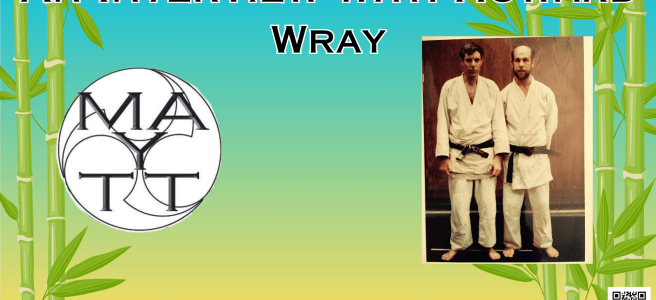
Howard Wray found judo through a night school where Al Wallace was teaching. Wallace would take his students down to Philadelphia and introduce them to his instructor, Takahiko Ishikawa. From then on, Wray began to learn from both judo men. In this conversation in the summer of 2023, Wray recalls how Ishikawa structured his classes at the Ishikawa Judo Club. This is the second part of a two-part interview. Read the first part here.
The other thing that comes to mind with these changes is when I went to a contest right before the coronavirus mess – I went to the Liberty Bell Tournament – and I was watching them compete. I noticed two things: one, they don’t do as much mat work and two, they do an awful lot of trying to grip somebody. We never played for grips. We bowed in, just grabbed and go. We never tried to keep out gi away from the grip – grip fighting stuff; we didn’t do that. Just grabbed a hold of the gi and went. If the guy was a southpaw, he would grab you left side or right side or whatever. He might have grabbed you behind the neck, but he didn’t keep fighting you for the grip. Today, I noticed that they seem to fight more with the grip. It’s completely different from what we used to do. They don’t let them stay and do mat work very long. They seemed to have eliminated that.
They even stopped kani basami, the scissor throw. You would throw your body up in the air and your one leg hits him on the belt side and your other left right below his knees. And your scissor him and he flies backwards. They stopped that completely during my time because too many injuries on the knees. Too many people got banged up on the knees, so that was eliminated. And the flying armbars, they were eliminated. You’d have karate people jump up and kick you in the face and stuff; you’d jump up and put one foot on one side and the other on the other side and you would take them down, like Bruce Lee or somebody. So, they eliminated a lot of things that people got injured doing. They just keep making it safer and safer and the competition has gotten, I don’t know what.
I’m not sure if it’s milking judo down, because not everybody’s a champion, and not everybody’s a teacher. I don’t know how you balance it. For some people, they could be gifted athletically and be champions without having to worry about their athletic ability, while other people have to work like crazy. I had a heck of time learning Japanese! [Laughs] Sensei helped me tremendously. I had a terrible time. I had a hard time going through high school, learning Japanese was a whole new vernacular! [Laughs] But Sensei was so good at it and so used to explaining it and showing you to help you understand it even though he didn’t have a mastery of English at the time. He knew his sport so well that when he showed you an armbar, he showed you from a hold down to an armbar and choke to an armbar. It was amazing – how to get away from a choke; how not to be strangled. It’s really an art form and I hope they keep it going as it was. I don’t know how they’re teaching it today.
I learned some self-defense from Sensei because of the kata, but I learned more from Jerry Goldman or what Al Wallace taught me, because they taught me strictly self-defense. Judo came after, because you couldn’t get rank in self-defense – you couldn’t get a black belt in self-defense. You don’t have a belt for that. So, I learned a lot from them in that category. And now, judo has gotten further away from the self-defense portion, from the jujitsu portion of it.
Anyway, there was dear Mrs. Foos, Helen Foos, who was quite wealthy at the time and had a lot of money. She was the one that helped him go down to Virginia Beach and bought the dojo down there. She backed him. She was a pistol too. I don’t know what else she did, but she backed him and took Sensei’s kids in and everything. Sensei had three kids, a boy and two girls. Hajime, the son, committed suicide at the age of fifteen or sixteen. He wasn’t very old. That was terrible.
That’s hard to say what Sensei’s legacy is because I don’t know what judo is today. If I knew what they were doing today, if it’s anything like the way he did it, it would be a heck of a legacy. I’m not sure if they destroyed it or whether it’s still going on or what. It depends on who’s teaching it, I guess. Tommy Blair should have some stuff in him. Joe Condello definitely has it in him because he was with him for years. Me – I was with him for about eight years. It’s really something. I hope he left a legacy. I wish, somehow, it kept going like he had it, but I don’t know if it did. Because I don’t know what Art Bourgeau did; I don’t know what he really did. I remember Art in my class, but I don’t think he was a black belt when I left. [Laughs] I don’t know whether he was or not. I think art has a whole different perspective of Senesi than I do, but I’m not sure of that.
When you’re young and you’re involved in something, you don’t think about sitting down and talking to a gentleman about other things – it’s all about the sport of judo. It’s not about how the heck did you get here. [Laughs]
Tommy was a young man when he was at the club, I remember that. He started with Mrs. Foos. Her judo children were out in Merion on Montgomery Drive, out in Bryn Mawr and Ardmore. She had a place out there. It was a nice house, and she had a barn and she wanted to put judo in the barn. The township wouldn’t allow her to do that, so she put it in her living room. She took out the living room and put mats in there. She’d put foam around the fireplace so anyone who would hit the fireplace would hit the foam instead. They did judo. I think she was the first woman black belt, at least in this area. And at the time I met her, she was a sandan, which was something.
When I was very young and was out there, I went to her club. I don’t know if I had a gi at that time – I don’t think I did. The kids were throwing me around and beating the heck out of me. Somebody said, “Anybody that leaves this club won’t amount to anything in judo.” And I disappeared because I didn’t like the way she was teaching. She was very abrupt with her teaching. She was ok with the kids, but she wasn’t my kind of teacher. So, I left. And that’s when I met Al Wallace. He, one day, tells me we’re going to see some judo. Where does he take me? He took me to Mrs. Foos’. I’m saying, “Oh my god, I’m going back.” So, I went to Mrs. Foos’ and Al taught that night because he was a guest with her, and he knew her. That class was okay. Then we go to a contest and I’m fighting Mrs. Foos’ kids and I’m beating them. The only thing she said to me that day was, “I made a mistake with you.” I didn’t say a word; I just ignored it and stayed where I was. By that time, Al was leaving to live in New York, and he was taking me to Ishikawa. And that’s how I got to know Mr. Ishikawa. After that, there was no place to go but Mr. Ishikawa. [Laughs]
The reason Tommy and I don’t talk much anymore is that he wanted me to teach at West Chester and at the time, I was doing something, and I couldn’t do it. I turned it down, so I didn’t teach at West Chester. Tommy had a falling out for some reason over that, because I haven’t talked to Tommy in years. He was just a young person at the time, and I gave them Ardmore YMCA and I gave him the Mainline School Night, cause that’s where I was teaching.
I taught at colleges for about five years; it was 1985 when I retired. I guess it was 1979 to 1985 when I taught at the colleges, and I don’t have a college education. [Laughs] That’s another interesting story. So anyhow, I got a job at Temple University. Once Temple hired me, everybody would hire me. [Laughs] It opened up Pandora’s Box. Anyhow, I have students who still keep in touch with me from college that I only had for one semester. It’s amazing; I can’t get over it. I don’t know what the hell I did; I must have done something right. They call me up periodically or send me Christmas cards or birthday cards. It’s amazing. And now my students are fifty-five years old, some of them. Time flies.
I had one student who challenged me once and he never came back. He wanted me to treat him like a black belt, and he wasn’t even a decent white belt. He tried to take me, and I only threw him hard once. He didn’t come back. Because you can throw somebody and while they’re in the air, you have control of their body. Think about it; when they’re up, even if they’re only up just slightly, you tilt them, you have control. You pull up on the arm and they fall on their side – they can’t even take a break fall correctly. [Laughs] You have them! And don’t know if people know that when they teach today. When you’re throwing, and you have control, it’s amazing what you can do. It really is. It’s actually very scary. That’s why people today always carry guns instead of doing martial arts.
Everything seems to be political today too and I hate to think how politics gets into it.
When I was teaching at the college, my first job teaching at the college, I said to my students, “I’m not going to give you a written exam. If you show up and you work and you try, you’re all going to get an A.” They looked at me and asked if I was serious. [Laughs] And I said I was dead serious; I wasn’t going to give them a test. The man who hired me from Temple University didn’t say I couldn’t do it. So, the first semester, all my students got As and nobody said boohoo. If you took my class three days a week, you got three credits; if you took my class two days a week, you got two credits; if you took my class once a week, you got one credit. That’s how I worked it. They all could get As and they did.
Then one day, while I’m teaching, I gave them the same speech every semester for five years. Two students, a boy and a girl, said, “You gave me a B. I deserve an A!” I looked at them and said, “You didn’t come to all my classes. You didn’t give me a good excuse as to why you couldn’t make it. I told you if you had a death in the family, if you were sick, or something serious came up, I’d give you a break. You didn’t do that. And since you didn’t fill out the requirements I put out, you get a B.” They complained and carried on. Then my boss came to me, telling me I have to make a test. He said, “Make three tests. You make an easy test, a medium test, and a hard test. You pick the test you want to give them.” So, if I don’t like them, I give them the hard test. Every semester after that, I had to give the test. I couldn’t get over it. Two students ruined it for everybody.
When Ishikawa announced that he was leaving, I think everyone’s reaction was mostly shock. [Laughs] I was basically shocked because he was talking at some point during that time about retiring, because he was getting older, and he wasn’t like what he used to be. And I can understand that fully because I stopped teaching at the colleges when I was forty-three. I didn’t want to get so old that I couldn’t handle myself, because then people don’t respect you at all. [Laughs] I think it was some sadness and sorrow that he was leaving, but at least we could go down and see him. It wasn’t like he was going out to California or going back to Japan at the time.
So, he had a huge, grand opening, which everyone showed up, including everybody: Jimmy Takemori, all the big wigs showed up at the grand opening of his dojo. There might even be some film about that somewhere. I remember that vividly. It was a huge thing and, God bless him, he let us sleep on the mat, use the showers, and we didn’t have to go out for any motels and stuff. He had a big thing and food, and everything else. Unbelievable grand opening. We had contests, we had black belt randori-ing with you. It was a huge ceremony and that started him down there. Joe Condello can speak more to that because he actually moved from up here to down there. I think he even changed his college just so he could be next to Sensei. He trained with him the whole time he went to college.
But it was a beautiful dojo. I don’t know how much it cost. And he used to live not too far from there, and he was not too far from Virginia Beach. I don’t even know what’s on that property now because it was all demolished. It’s a real shame because it was a beautiful dojo. And Mrs. Foos, I’m not sure whether she taught down there or not.
I used to go down in the summertime when Sensei moved to Virginia Beach. When he was leaving to go back to Japan, Frank Heifer came to me and said, “We should go down to see Sensei and take him out to dinner.” So, I took him down. I had a Honda CR-X two-seater, and we drove down to Virginia Beach. We stopped and saw Sensei, and we took him out to dinner. We’re pulling into the driveway after dinner and Sensei says to me, “Howard. You want to see the dojo?” [Laughs] “Sure Sensei.” And here, it’s going to be demolished and the dojo was exactly like it was when we used to go down there during the summertime. The plaques were on the wall, the trophies were in the case; everything was just like it was when we were training down there. I couldn’t get over it. I asked, “Sensei, they’re going to demolish this?” He said yes. Then he came over and handed me a wooden sword. Then he came over and gave me something else. Frank said something and Sensei said, “Frank, take anything you want.” So, we took the diplomas off the wall. We took as much stuff as we could get into the car. We loaded it up, box, stock, and pickle barrel. Frank said at the end of this, “We should have taken a truck down here, Howie! We could have taken the mats and everything!” They destroyed the whole thing and it got demolished. I had the good fortune of giving Atsuko and Fumiko, his two daughters, some of the stuff. I still have some stuff left over which I’m going to give to some people I know in judo. I know Joe Condello is going to get some stuff. I want somebody to have it that was somebody that was trained by Sensei. But it’s really sad. Things just get shuffled.
I stayed in touch with Sensei when he went back to Japan. I sent him Christmas cards and stuff. His wife sent me letters and stuff. I forgot all about them. I looked them up the other day and they were just amazing. I had a hard time in the later years – we all do. He was an amazing human being. There’s nothing bad I can say about Ishikawa.
I guess he was a great human being. It wasn’t about money; it was about the sport of judo. It was almost like a way of life for him. He was just so kind. He let me train with him without paying him. [Laughs] Who does that? So, I did something to injure myself; I think I broke my shoulder. I couldn’t afford to pay him, so I didn’t come. He actually called me up and told me to come; it didn’t matter about money. This was before money became so powerful. “You come and train. Judo more important than money.”
I said, “Sensei, I can’t afford to pay you.”
“I know. Just come if you can, if you’re physically able, come.”
So, I went and trained with him. To pay him back, I tried to pay him back by the visit. At that time, it was about three dollars a class – it was not very much. Classes might be an hour long; he didn’t care if you stayed after class and practiced. He let you do what you wanted to do. You could stand in front of the mirror and do your uchi komis. One day, he caught me paying Trudy, his secretary at the time, three dollars. He said, “No, no, Howard. You pay by the month!”
I said, “What’s this? I’m trying to pay you back!”
He said, “No, no, no. you pay by the month.”
So, at the time, I know it was fifteen dollars a month. So, I paid the fifteen dollars a month. Then when I got black belt, he raised his prices to twenty dollars a month, I think. You would get four classes for twenty dollars. I went to give him twenty dollars. He said, “No, no, no, Howard. You’re black belt now. You’re fifteen.” [Laughs] I couldn’t even pay him back! [Laughs] He was just an amazing human being. And the reason I couldn’t make a living in judo is because Sensei was living in 207 North Broad in the upstairs in the back room. He was where we kept the gis and stuff. He went out to eat because he couldn’t cook there because there was no stove there. He slept in the dojo too! He lived in the frickin’ dojo. He was a seventh-degree black belt, the highest rank in the Western Hemisphere, and he was living in the dojo.
He was just a very nice, kind human being. I don’t know how to explain it any better than that – he was a great person. He was just exceptional, he really was. I don’t even know how in the world we were so lucky to have him even come to this country and train. One of my students sent me a book for my birthday and judo, in the beginning, was only for the elite in this country. You had to be somebody important to do judo. [Laughs] And then it filtered out to the common person. It’s amazing that it went where it went. I don’t know where it’s going now, because I’ve been out of it for so long but, unfortunately, a lot of stuff is mostly political. At the time that I was doing it, it was really something. And Sensei was the epitome of the whole thing. He was the cream of the crop. I can’t put it any better than that. He was just a kind human being, who cared about his students, cared about learning the right way to do something, and knowing it completely – it wasn’t just one particular throw; he taught us the whole gambit of all the throws. I never saw him criticize or get mad at any student for doing something wrong. He would come over and say, “Tilt your head. Don’t put your head in the center, so your body weight goes that way.”
I can still see him doing the ko uchi gari and o soto gari. I was amazed at that one because most people go ko uchi to o uchi, but Sensei would go to ko uhci – hit them a little bit – then circle around the leg and get you right behind the knee, pick it right up, and down you go. Keep the elbow in and down you go. You’d have to see him to believe it. When he moved his feet, if he wanted to move them fast, it looked like a blur. He was that quick! [Laughs] And when he threw you, he didn’t throw you hard, he threw you enough to let you know that you were down. He didn’t pound you into the ground. Sensei was just a great human being.
This is the second part of a two-part interview. Read the first part here.
Find out more about Wray, Ishikawa, and more in Takahiko Ishikawa: Judo’s Quiet Master!


 Martial Arts of Yesterday, Today and Tomorrow