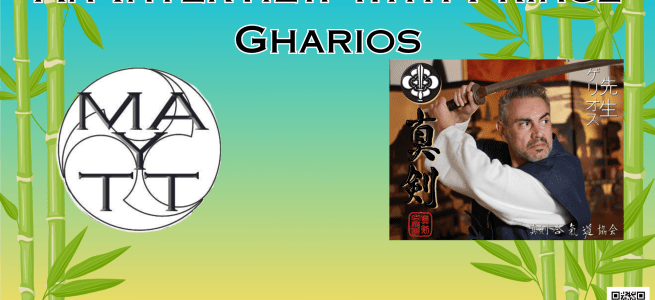
Prince Gharios began aikido in Brazil in 1986 and during the rise of the Ultimate Fighting Championship, he was forced to look to other sources for a more direct aikido. By the mid-1990s, Prince Gharios found Steven Seagal and Tenshin Aikido, which gave him the tools and foundations to establish his own Shinken-ryu Aiki-Budo. Today, in this exclusive interview, Prince Gharios took some time to discuss his new book, You’re Doing It Wrong!, what ails aikido, and what are some options to help cure the problem. All images provided by Pring Gharios. This is the second part of a two part interview. Read the first part here.
MAYTT: Though you outlined this in your book, if everyone in the aikido world follows your suggestions, what would this new aikido of the future look like?

PG: Well, I think what I’m doing looks a lot like what the founder envisioned before the Second World War. I’m not trying to reinvent the wheel; I’m just trying to return to what O-Sensei taught. Who am I, after all? I’m just a student, nothing more. But because of the path I was placed on, I had to dedicate myself. I never wanted to teach at first. I was put in that position, and once I was, I had to make it work. That forced me to learn Shinken Shobu very early on. I was always apprehensive – afraid I might be humiliated in front of my students, or worse, that someone could seriously injure me. You’ve seen the UFC; you never know what could happen. So I had to give birth to Shinken Shobu in my own practice. I know what that feeling requires, and I know the mechanism that supports it.
The truth is, every great movement led by a charismatic leader has been misunderstood after that leader’s death. Jesus, Muhammad – and every major spiritual or political movement has faced this. A visionary sees something clearly, but it’s hard for others to grasp that same vision. In my humble opinion, this happened with O-Sensei too. If you read his writings, or look at what Shioda, Saito, Minoru Mochizuki, and other great masters said, they were all repeating the same message: Shinken Shobu. Train seriously, because if you don’t, you’re not practicing aikido.
But of course, reality interferes. Dojos need to rent space, instructors need to feed their families, promotions need to be given, compromises get made. I understand this because I lived it. I was never financially successful as an aikido instructor; I was always investing my own money. Many of my students couldn’t afford tuition, but I let them train anyway. My ex-wife used to say I had sixty “kids” I was supporting. But I believed in them, and today some of those students are masters themselves, with their own students because I let them train for free when they needed it.
So what do I think aikido of the future will look like? If I had to describe my vision, I’d say it will be smaller, less widespread. Because seriousness requires dedication, and not everyone is willing to give that. Every philosophy, religion, or system has three layers: the esoteric, which is the outer practice for the general public; the esoteric, which requires deeper understanding; and the secret, the okuden, the inner teachings that only the truly dedicated can grasp.
That’s where I may sound polemical, but I don’t think aikido is for everyone. Anyone can practice it, yes, but few will actually want to. Especially today, people prefer something they can do three times a week without homework or extra effort. Aikido demands intellectual and personal dedication. And in this TikTok era of short attention spans, that’s rare. Before World War II, there was no television, barely even radio. People had more free time, even while working, to devote themselves to a practice like aikido. Today, they don’t. So I’m not saying people who aren’t intellectually developed can’t practice aikido. What I’m saying is, most won’t want to. For example, people sometimes come to me asking if aikido is good for self-defense. I tell them no. Go study karate or another art; within six months, you’ll have something usable. In aikido, it takes at least until black belt before you begin to see things differently. For pure self-defense, aikido is a terrible choice – the juice is not worth the squeeze, as the saying goes.
So my view is this: anyone can practice aikido, you don’t need a PhD or a high IQ, but you do need devotion. And that devotion is rare today. Most people want immediate gratification. They want to be able to beat someone up right away. aikido is not about that, as you well know.
MAYTT: You bring up Shinken-ryu. What was the driving factor in establishing Shinken-ryu for you, and then what was also the reasoning in choosing the term Aiki-Budo over aikido?
PG: Well, Aiki-Budo was the name O-Sensei used for aikido before the war. That’s why I chose to keep budo in Shinken-ryu, to honor that original vision. Shinken-ryu means our initial goal is Shinken Shobu. Here’s the thing: when people talk about aikido today, they often misunderstand. If I give you an analogy: it’s like trying to do paranormal tricks, or the so-called non-touch techniques, before you’ve learned the basics. I actually believe some of that is possible, but it’s not as common as people think. It’s like a toddler trying to run before knowing how to walk. You’ll get there eventually, but first you need to walk well, then you can run.
When people say, “I want to do ki work,” they don’t realize that if you train properly, ki will naturally develop. That’s Shinken Shobu. Our bodies already know aikido, but as we grow up, we forget. Social conditioning interferes. Think of a baby: when it doesn’t want to be picked up, its body suddenly feels heavier. That’s ki in action. Or the classic story of mothers lifting cars to save their children. Why does that happen? That’s Shinken Shobu: the emergency state that unlocks extraordinary strength. The difference in aikido is that you learn to control it and use it at will. That’s why Shinken Shobu is so important.
I was debating someone recently, and he said, “There are many ways to reach the top of the mountain.” I said, yes, but if you’re walking in the opposite direction, you’ll never get there. If your goal is to see the sunset, but every morning you run east, you’ll never see it, no matter how disciplined or hardworking you are. In the same way, no matter how much you train, if you don’t train in the right direction, you’ll never reach the essence of aikido. I’m not saying my way is the only way. What I’m saying is that you must be aiming for the mountain – aiming at Shinken Shobu and takemusu aiki. Maybe my way is like riding a bicycle up the mountain, and others take different paths. But we all need to be heading toward the same peak.
Now, a personal note: when I was six years old, I was diagnosed with what doctors called a “zebra brain,” essentially, being gifted. But for me it wasn’t a blessing; it was a burden. I was bullied for it. My brain is wired differently; it’s larger, with unusual connections. It doesn’t just affect intellect, it affects perception. That’s why it took me so long to write this book. To me, all these things are obvious. But apparently, they’re not obvious to others.
That’s why I always say: go back to what the founder wrote, and to what his direct students – those who trained with him when he was younger – said. Because after he was fifty, sixty, seventy, he shifted heavily toward the spiritual side. I understand that, but if you look at the videos of him training shirtless, you see he never abandoned the physical practice. On YouTube you can even find clips where he asks his students to attack him by surprise. Why did he do that? Do you know any sensei today who asks for surprise attacks? No. He did it because he wanted to keep polishing his Shinken Shobu. That’s the key: staying sharp, always training as if your life is on the line. That’s how you develop the ability to handle multiple attackers, and that’s how you learn to control those “superpowers” instead of waiting for an emergency to bring them out.
MAYTT: With your experience of needing to make aikido work during the onset of the UFC, do you feel that experience made you more open to seek out Steven Seagal or Haruo Matsuoka, where their aikido style was focused on applying technique no matter what?
PG: Well, after around 1993–1995, I started having a lot of police officers and security people as students. By the end of 1998, when I was already with Seagal, I had the opportunity to teach the Brazilian federal police – the equivalent of the FBI in Brazil – as well as the VIP security teams of HSBC bank, including their bodyguards.
I once read something O-Sensei said: “Bugei wa bugei desu. Aiki wa odorijanai.” Which means, “Martial arts are martial arts. Aiki is not a dance.” To me, that was straight from the horse’s mouth. So I thought, these people aren’t doing what Sensei himself said. Let’s find someone who does. Also, I think aikido is a very beautiful martial art. But I’m not as tall as Seagal; I used to be six feet and a half inch, though now I’m closer to six feet at fifty-two years old. Still, I was always tall and heavy. I couldn’t do the aikido that smaller people could do, so Seagal’s technique was a very good fit for me.

If you ask me today who has the best technique out there, from what I’ve seen – though of course, I haven’t seen everyone – it’s Lenny Sly. His technique is how aikido should look. That said, I was always a little slow at learning. It actually took me six months just to learn how to fall. I was very mental about everything, and it made learning the basics difficult. That’s why it took me six years to get my black belt. I remember seeing people come in and pick things up in two classes. They’d look at me like, “How can you not do that? It’s so easy.” But I persevered. Six months later, I was still there, while those people who learned quickly had already left—they got bored because it was too easy for them.
So, I think things happen for a reason. And to answer your question, yes, that’s why I felt compelled to go. I wanted that specific aikido because I knew it was efficient, I knew it worked, and I knew it was right for me as a tall, heavy guy.
MAYTT: It would be safe to say that Tenshin Aikido, or the principles that Seagal has imparted on you have formed the basis of Shinken-ryu, or have other approaches helped form that basis?
PG: Well, here’s the thing, the people who practice today, I’m not aware that they really engage in the esoteric side. They’re very good on the physical side, but I don’t recall them going deeper into the spiritual aspects. I know Matsuoka Sensei, especially after he left Seagal, went to Seiseki Abe Sensei and became more spiritual. But Reynosa, I don’t think so. I was really the only one who was interested in the Buddhist side of things. None of the other students actually studied Buddhism. I even found a Tibetan master in Brazil and went very deep into it. I was initiated into Tibetan Buddhism, in the Nyingma tradition. That said, the physical part of the training is excellent. It’s a very strong technique, and I totally recommend it.
MAYTT: Since striking out on your own with Shinken-ryu, how do you feel that your aikido has evolved, on your own and leading an organization?
PG: It’s very interesting because, although in the last eight years I haven’t been physically practicing much, I have been doing some classes in a few dojos here. I’ve been trying to support my schools, helping with political aspects, and Aikikai promotions for my students. But it’s funny, over the past fifteen or twenty years, I’ve been practicing in my head. You’ll laugh, but when I’m in the shower, I’m mentally running through techniques. People would ask me, “Have you been training?” and I’d say, “No, I’ve been training in my mind.”
I’ve even seen two scientific studies that prove this works. In one study, they had two groups: one doing biceps weight training and the other just imagining lifting weights diligently for an hour a day. When they measured the biceps, both groups showed growth. The other study involved people who had never played the piano. One group practiced on an actual piano, and the other just imagined playing. When they measured brain activity, both groups developed the same neural connections. So, thinking about something is actually a form of practice. For example, people who have long commutes can train in their minds. But you have to focus, which is very hard today with all the distractions from phones and other devices. If you have a meditation system or something to help you concentrate, you can actually see real results. It’s really amazing.
MAYTT: You can definitely see martial artists who think more about the art than those who do not.
PG: Both are vital. You cannot do aikido without both. That’s why people don’t understand. It’s not like, “If I do the techniques efficiently, I’m good.” No, you’re not, because you need the other side. “If I just do the energy and say…” No, you need both, otherwise it’s not aikido – it’s something else. It might even be something better than aikido, but it’s not aikido.
MAYTT: So, you trained with Seagal, Matsuoka, and Reynosa, then to Yamada. How did the transition from Tenshin Aikido to Mainstream Aikikai Aikido and learning from Yamada affect your aikido understanding?
PG: I had a deal with Yamada Sensei when I left Seagal and Reynosa. I approached him and said, “Sensei, I have a very particular way of doing the techniques. If I’m not able to continue teaching the way I teach, my black belt test requires randori at full speed with three people. You have to be able to survive at least fifteen seconds of that.” He told me it was fine as long as my students could perform the basic Aikikai techniques, like the minimum requirements for the kyu ranks. I said, “That’s very easy, but we see things very differently.” He agreed it was fine. I also told him I didn’t want to be involved in any politics or other organizational matters. Ultimately, the reason I left was because my own students wanted to connect directly to him. I told them that it wasn’t something I had to worry about, but they had a plan and went ahead anyway, so I left.

The techniques, in terms of style, were like water and oil – completely different. But from 1990 until 1995–96, I trained in basic Aikikai, so I knew it. I modified it myself, but whenever I went to São Paulo, I still had to demonstrate the basic techniques. It worked during those fourteen years. What I’m very grateful to Yamada Sensei for is not just the Aikikai connection, but also the opportunity to train with other O-Sensei students, like Nobuyoshi Tamura. Before that, I had my shodan from Kobayashi Sensei in 1993, so I trained with multiple direct students of O-Sensei. Some people assume I only value Seagal’s technique because I never trained with real O-Sensei students, but that’s not true. I was a student of one for fourteen years.
Yamada Sensei, God rest his soul, was a true promoter of aikido. He wanted to make it grow rather than be selective. I respect him immensely. He was a Shihan, trained with O-Sensei, and was following what he understood O-Sensei taught. That’s why I always say I’m not claiming anyone is doing anything wrong. We’re just facing a crisis, and I’m trying to diagnose the reason. I urge people to look back, not at what I say, but at what the founder said, and at the words of those who knew him. There are countless quotes from Shioda, Mochizuki, Sunadomari, and Morihiro Saito all emphasizing Shinken Shobu. O-Sensei was very adamant about it. Shinken Shobu was central, and this isn’t something new.
MAYTT: Final question: What is the biggest takeaway that you want readers to walk away after reading your book?
PG: One of my greatest crusades in life is against something I call stupidity. Do you know what stupidity is? It’s not ignorance; ignorance is natural. We’re all ignorant about something; it’s impossible to know everything about everything. Stupidity, however, is the denial of expertise, logic, and critical thinking. It’s when you make a judgment based on emotion rather than reason.
What I see happening today among many aikidokas is that they hide behind feeling good. Positive emotions, friendships in the dojo, everyone smiling, the smell of incense—it’s comforting. And if you have a black belt, you have status. You didn’t necessarily have to prove yourself in combat to earn it, so there’s a temptation to believe you’re a master without testing it. There are traps here, some of them dangerous. As I wrote in my book, there’s a chapter called “Grandmasters Who Cannot Fight and Students Who Think They Can.” That’s exactly it. You might be a sandan, third dan, but if you’ve never truly tested yourself, you could be destroyed in a real confrontation.
I always say that you need to apply logic and empirical thinking, even to things like religion or martial arts. Examine your dojo and your master critically. They may be the most virtuous person in the world, almost saintly, but ask yourself: is this really aikido? Don’t be fooled by O-Sensei’s smiling picture, which I love and have myself. He was a very violent man and had to restrain himself. Efficiency in aikido is not the same as violence, but you have to be aware of the difference. Don’t be seduced by comfort – the idea that you’re protected or that testing yourself is unnecessary. True growth in aikido is uncomfortable. It’s challenging to always try to be at the top of your game. It’s easy to just train casually, pretend to spar, and call it fun. That’s dangerous and it creates traps. My advice is: if, after careful, rational, and empirical examination, you are happy with what you’re doing, then by all means, continue. But if you sense something is wrong – if, like Hamlet said, “there’s something rotten in the Kingdom of Denmark” – then question it. Compare what you see to what O-Sensei actually said, and see if it holds true.
I am open to guiding and helping people, but I don’t want to build a large school or have students representing me. I have other projects: humanitarian, educational, and international work. I am not a professional shihan. I only want to teach a small number of people committed to this vision, which I believe is the modernized vision of O-Sensei. I can guide you without formal affiliation. If someone is truly committed, I feel a duty to help. But I also say no to those who are not ready or who want to start aikido from scratch; I can only help improve existing practice. Otherwise, find your own way. Locate the mountain, imagine a better path, and if you discover something superior to my method, come and tell me. I want to know the best possible way.
MAYTT: Is there anything else that you would like to cover before we end?
PG: I would ask you to emphasize that I’m not claiming to be a prophet, nor am I pointing fingers or saying people are doing things wrong. This is meant as a provocation; sometimes, when people have been in a trance-like state for too long, you need to shake them awake. That’s what I feel this book is doing: shaking people and saying, “Listen, if we don’t act now, aikido might die or become a fringe practice.” Covid was devastating for this; many dojos closed and will never reopen. If we don’t actively revive and sustain aikido, it will be a serious problem. Aikido is an incredible art. It has profoundly influenced my life; it has shaped my philosophy and everything I write about. To me, it’s not a hobby or a sport; it’s a way of life. The founder codified something truly beautiful, and it’s a shame that it’s not being pursued in the way he intended.
MAYTT: Thank you for this great conversation!
PG: It was a pleasure being here!
This is the second part of a two part interview. Read the first part here.


 Martial Arts of Yesterday, Today and Tomorrow
One thought on “Interview with Shinken-ryu Founder Prince Gharios: Attempting to Save Modern Aikido, Part II”