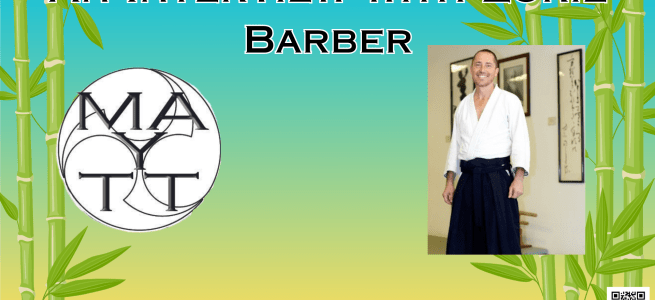
Zorie Barber was first introduced to Shotokan Karate with Ski, or Gerald Evans. While in college, Barber felt he needed to go to Japan and train with some of Ski’s contemporaries. He arrived in Tokyo and endured a hostile training environment until he moved out to see Kyoto, stumbling onto the Tenshin Dojo under the direction of Miyako Fujitani. Enamored, Barber took to the aikido training, ultimately finding Haruo Matsuoka in Los Angeles when he returned and later Tenshin-ryu Hyoho when he later lived in Japan recently. Today, Barber took some time to talk about his time in Tenshin Aikido, his new project Dojo Pop, and finding and learning Tenshin-ryu Hyoho. This is the second part of a two part interview. Read the first part here.
MAYTT: When you found him again in 1995, did you notice any sort of change in his instruction and in his aikido?
ZB: No, it’s completely different. When I first started practicing with Matsuoka, I was maybe one or two years out of the Tenshin Dojo in Osaka. Back then, they were doing techniques that were almost the same as Seagal’s – focusing on covering and that sort of thing. But Matsuoka’s instruction really evolved over time. He would still teach those hand techniques, but it became something else entirely.
Calling it “different” doesn’t quite capture it. It was more of a total evolution. I don’t want to say it became soft, because it didn’t. It’s almost indescribable, to be honest. I was even working on a documentary called The Mysterious Technique of the Cat, and maybe I’ll still do it. The documentary was essentially asking the question, “What is aikido?” When I first started practicing, I could have told you exactly what it was. But now, it’s like trying to grasp something intangible, something unspeakable. It’s a total mystery.
What Matsuoka was doing became more and more mysterious, yet it was also very grounded. He doesn’t talk about things in mystical terms – he’s very focused on the physical aspects, like fascia and body movement. He doesn’t talk about concepts like Motoko or Kotodama. But despite that grounded approach, there’s something completely mystical about what happens in his classes.
If you get the chance, you should definitely go to one of his classes. Do whatever it takes to get there. I remember one summer, he was teaching in Europe, and I was always jealous of the guys who got to be his uke when he traveled. I finally got off the plane in Italy, determined to be one of those guys. An Italian guy asked me, “How do you do it, man? I want to be able to do this like you.” I sold my car to go on that trip – I sold my Land Rover. That’s how much it meant to me. So whatever you can do to practice with him, if you’re into martial arts, it won’t be a waste of your time.
MAYTT: What do you feel is the or was the most impactful lesson Matsuoka gave to you that still resonates with you today?
ZB: I mean, he gives me chills. I think it’s important to know that this isn’t like getting a college diploma. This is something you’re going to spend your life doing, or you shouldn’t bother. He never explicitly told me not to quit – he never said it outright. But that’s the essence of his teaching; he teaches without speaking. He didn’t talk to me for the first ten years I knew him. He wasn’t rude or ignoring me – he’d say “hi” and ask how I was doing. I’d respond, “I’m good, thank you.” Then, one day, we were sitting in class next to each other, and he said, “I was chanting the Lotus Sutra the other day and had a deep insight into martial arts.” I was stunned. After ten years of hardly speaking, he suddenly shares something so profound. It was surprising because he’s a Buddhist and had never talked to me in depth before.
It’s not like other experiences where you hang out at the bar afterward. My first karate sensei, Ski, would break out a chess board and chew hash while playing chess with everyone. Matsuoka Sensei is different. He’s not like that. He comes to class, teaches, and is social and funny. He tells jokes and engages with people. The transmission happens not through words but through his presence and teaching.
MAYTT: Moving to the broader topic of Tenshin Aikido, do you feel its relation to Seagal has had a positive or negative impact on the art?
ZB: I think Seagal has had a huge positive impact on aikido. Without a doubt, he’s brought aikido to a whole generation of people who might never have heard of it otherwise. Even people like Andrew Tate wouldn’t have known about aikido if it weren’t for Seagal. I know several high-level instructors under Matsuoka Sensei who only got into aikido because of Seagal. Some of them are still stuck on trying to emulate him. I get it—when I was eighteen or nineteen and saw Seagal in Above the Law and Out for Justice, I thought he was cool and wanted to be like him. But as you grow up and continue practicing, you want to be more like yourself.
I see no negatives about Seagal’s influence on aikido. However, I do think we need someone else to revitalize the popularity of aikido. It’s a unique martial art – more than just a thinking man’s martial art, it’s a transcendent one. Aikido goes beyond simply being tough and beating someone up. If you dive into it deeply, like Matsuoka Sensei shows, you can experience profound changes in your body’s energy and structure in just ten seconds. You can’t achieve that kind of strength even after decades of gym workouts. Matsuoka Sensei has taught me so much, even how to walk properly. After ten years, I’m still learning the basics. It’s a cliché but learning how to move your body correctly is fundamental.
In terms of Tenshin Aikido today, I’m aware of a few places: Fujinami Sensei’s dojo in Osaka, Gary Sensei’s dojo in Indiana, Bartłomiej Gajowiec in Warsaw, Thierry Body in Belgium, the Spanish brothers in Siberia, and Danny Diaz in southern Spain. I’m sure there’s a larger Tenshin Aikido group still under Seagal Sensei, but I’m not familiar with them or their social media presence. I occasionally see posts from Tenshin Dojo Europe on Facebook, but I don’t know much about the broader Tenshin Aikido world outside the Matsuoka bubble.
MAYTT: I talked with a few other Tenshin practitioners, and they all mentioned that Tenshin Aikido has an isolating aspect.
ZB: I think it’s straightforward. Just look at the lineage. You can say whatever you want about being part of Tenshin Dojo, but let’s see if the lineage checks out. I’m working on a project called Dojo Pop – Dojo Proof of Practice. We’re tracking attendance and recording it into a 200-year decentralized data storage archive. If you claim to be part of Tenshin Dojo, who’s your sensei? How long did you practice with them? What did you earn? If everything lines up, great. If not, well, whatever.
One of my missions now is to start recording this data because, when I started in Osaka, Fujitani Sensei gave me a membership card. It was my prized possession. Every time I went to class, I’d drop it off, get it stamped, and that was proof I was there. I lost it one day, and now I’m recreating that concept in a technological way. So, your grandkids will be able to see who you practiced with and when. If you want to practice in Brazil, you can show up with your Dojo Pop passport and prove your practice history.
At the same time, I have no problem with people practicing in an insular or tribal way. I think walls can make strong communities. But practicing only with the same people and never branching out can lead to weakness. If you only train with the same guys doing the same techniques, people outside your system will crush you if you’re not aware of what they’re doing. From a self-defense perspective, it’s important to test your style and yourself against others. You can spend a lifetime practicing within your style and have tons of benefits, but you should also challenge yourself to see if what you’re doing is real. Sometimes, you need to get into street fights to test it.
MAYTT: You bring up Dojo Pop. When did it start to become a tangible thing and how have you seen it grow since then?
ZB: I had the idea for this project years ago – probably two or three, maybe even four or five. I entered a couple of hackathons with it, but my hacking skills weren’t great, so I didn’t get much traction and faced a lot of frustration. Finally, about six or seven weeks ago, I was working on building it in some software language and getting increasingly frustrated. One morning, after my usual yoga practice, weight training, and sword practice, I had a breakthrough. While meditating, it hit me: I could roll it out tomorrow by having people scan a QR code to record their attendance. That was six weeks ago, and now we have about ten dojos using it in New York, Mexico City, Chile, Ecuador, Colombia, Austria, the Netherlands, Madrid, and a few other places. We’re in alpha testing, and while it’s early days, we’re already reaching about 150 active users. We just completed our first monthly worldwide leaderboard for May, and we’re about to release the June leaderboard.
One of my colleagues, who runs about fifty schools with around 5000 students, is helping with the next iteration. We plan to roll it out to them for further testing and then expand from there. I hope that by Christmas, we’ll have between 5000 and 7000 users. The worldwide leaderboard is meant to encourage practice and competition, not to determine who’s the strongest practitioner. In a few years, I’d like to organize an annual gathering or jamboree where the top practitioners can demonstrate what they’ve been doing – whether they want to fight or not is up to them. The primary goal of Dojo Pop is to preserve the lineage by recording who practices and how long they’ve been practicing. This will help us maintain a record from the present into the future. I also want to roll up historical data, though that will take time.
The second goal is to preserve techniques. Techniques live in practitioners, and without proper documentation, they can be lost. I almost lost my sword lineage, but we managed to revive it. The next step is to use video to capture techniques in classes. We’ll store this on a 200-year distributed storage system called Arweave, which allows us to control access. If a lineage or part of it is secret, we can keep it that way, but if not, we can make it public. For instance, if you attended a class with Matsuoka Sensei in Belgium and checked in with Dojo Pop, you’d receive a special token granting access to the video of that class. This token can be passed to your students or family after you’re gone, ensuring the preservation of secret techniques.
We’re also working on long-term goals, like creating AI avatars of deceased teachers. Imagine being able to ask an AI version of Abe Sensei for feedback on your technique. This could be possible in a couple of years.
Ultimately, it’s not just about techniques and lineage but also about preserving the stories. The experiences and stories shared by teachers and students are invaluable. This conversation, for example, should be recorded on Dojo Pop for future generations to learn about the Tenshin Aikido lineage and its rich history.
MAYTT: I wish you the best of luck in reaching your goals with Dojo Pop.
ZB: You know, mission creep is a real issue these days. We’re focused on capturing the lineage for now. Step 2 is to start working on capturing techniques, which we’re already doing to some extent. Many people are recording their classes and live streaming them, so that aspect is already happening.
In a way, Dojo Pop is about collating all this information and building a community around it. The technology to store this data is already in place; I’m not reinventing the wheel or trying to create a Swiss Army knife. I’m just bringing together existing tools to benefit all martial arts communities, not just specific ones like sword or karate-do.
MAYTT: So you are looking for this app to be used across all different martial arts, not just Japanese, Chines, or sword arts?
ZB: Yeah, right now we’ve got karate schools using it, aikido schools, some ninja schools, and a bunch of sword schools as well. It’s completely non-denominational. We’re also discussing licensing the business model. I have another friend working on the new generation of all this tech, and they’ll need proof of practice too. So, even though it’s not a dojo, we’ll likely end up collaborating on the back end of what I’m doing.
MAYTT: Final question and you did touch upon this a little while ago, but you currently train in Tenshin-ryu Hyoho. What drew you to this art?
ZB: So, you know, in aikido we practice with swords too – there’s ken, jo, and all that. Maybe ten or fifteen years ago, Matsuoka Sensei had some iaido experts come and teach us. I remember Akashi Sueyoshi Sensei, who I think was a student of Kono Sensei. I’ve had a katana for a while and learned a few basic techniques, but I never really found anyone I wanted to study under. Then, about two or three years ago, a sword video popped up on my YouTube feed. It was from these guys doing Tenshin-ryu Hyoho, and I was blown away by how beautiful the techniques looked. I started following them, and there are three main Senseis: Tenshin Sensei, who’s around 81 and is the ninth-generation lineage holder; Kuwani Sensei, the tenth; and Ide Sensei, the eleventh. Kuwani Sensei is in his forties, and Ide Sensei is in his thirties.
Ide Sensei was offering a half-hour Tenshin-ryu class in English every two weeks, so I’d put on my aikido black belt and katana and follow along. It was great; I picked up some basics. When I came to Japan in July 2022, I emailed Ide Sensei saying I’d like to practice with them. He responded with, “Who are you and how long are you here for?” I told him I’d been practicing with Matsuoka Sensei for thirty years and was in Japan for a while. He said, “OK, come on over.”
When I attended a class with Kuwani Sensei in Yokohama, he was incredibly welcoming. He asked if I practiced with Matsuoka Sensei, and I said yes. He mentioned that Tenshin Sensei was best friends with Matsuoka Sensei’s teacher, which was a crazy small-world connection. I started practicing with Tenshin-ryu, and it’s been incredible. It’s reignited my passion for martial arts in a way I haven’t felt since meeting Ski in Philadelphia and discovering Tenshin Aikido in Osaka.
I was invited to Tenshin Sensei’s house on New Year’s last year, and it’s like a museum – thousands of swords, hundreds of sets of armor, a boar’s head. In a place of honor, he has a photo of the Osaka Tenshin Dojo. It’s wild how interconnected my martial arts journey has become.
About a year ago, Ide Sensei rushed me to change before class, which annoyed me at first. But it turned out he wanted to formally invite me to become a student of Tenshin-ryu. He showed me the lineage book, which records all students for the past 400 years, and invited me to add my name, thumbprint, and blood. I was thrilled and agreed. I asked what would happen to the book if there was a fire, and he said, “It’s gone.” That’s another reason why Dojo Pop is so important.
MAYTT: That is great how they welcomed you and how that gave way to thinking of Dojo Pop. How much of your previous aikido training helped you learn Tenshin-ryu or did you have to learn something completely different?
ZB: No, actually, I’d say they’re not very different. Tenshin-ryu isn’t just about the sword; it also includes spear, open hand techniques, and even sickle and chain. It’s pretty cool, but the core principles are quite similar. The biggest difference for me, and the hardest habit to overcome, is related to distance. In aikido and even in karate, I tend to stay close to protect myself. With sword techniques, though, the approach is the opposite – you get in, make your move, and then get out, creating space to avoid being within striking distance.
In aikido and Matsuoka’s style, I usually try to keep my body aligned vertically and avoid excessive movement, but with Tenshin-ryu, it’s almost like ballet. The movements are more extreme and require more stretching to get the tip of the sword into position and then retreat. Sometimes, you’re moving in to dominate and avoid the need to escape, but for me, the biggest difference is managing that distance.
MAYTT: Thank you for this great conversation, Zorie!
ZB: Thank you for having me!
To find out more about aikido and its history in America, click here.
This is the second part of a two part interview. Read the first part here.


 Martial Arts of Yesterday, Today and Tomorrow