
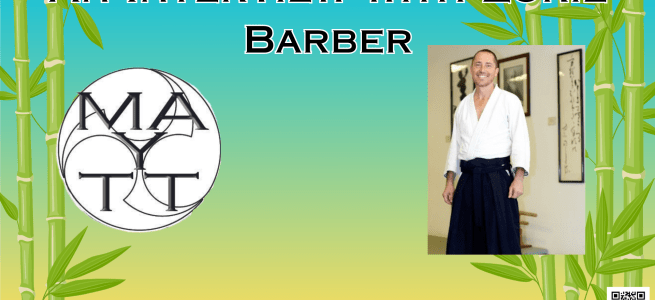
Zorie Barber was first introduced to Shotokan Karate with Ski, or Gerald Evans. While in college, Barber felt he needed to go to Japan and train with some of Ski’s contemporaries. He arrived in Tokyo and endured a hostile training environment until he moved out to see Kyoto, stumbling onto the Tenshin Dojo under the direction of Miyako Fujitani. Enamored, Barber took to the aikido training, ultimately finding Haruo Matsuoka in Los Angeles when he returned and later Tenshin-ryu Hyoho when he later lived in Japan recently. Today, Barber took some time to talk about his time in Tenshin Aikido, his new project Dojo Pop, and finding and learning Tenshin-ryu Hyoho. This is the first part of a two part interview. Read the second part here.
Martial Arts of Yesterday, Today, and Tomorrow: Hello and welcome Zorie!
Zorie Barber: It is great to be here!
MAYTT: Before you entered into Tenshin Aikido, you traveled to Japan. What prompted you to go to Japan and stay for a few years?
ZB: So yeah, it really started when I was in high school. I went to Germantown Friends School in Philadelphia, but I grew up in South Philly. A buddy of mine introduced me to a karate sensei named Ski, or Gerald Evans. He was this black dude from West Philly, probably in his fifties when I started practicing with him. He was awesome. After school, I would take his class, and he’d just share openly, teaching his kata and sparring with me. I knew nothing, right? But he was really my first introduction to Japanese martial arts.
After I graduated high school, I went to NYU for a year, but I wasn’t sure what I wanted to do. Then I heard that Ski had fought the Japanese champion, Tanaka, to a draw in the Budokan. So I thought, “You know what? I’m gonna go practice with Tanaka.” And by the way, I found out like thirty years later that Ski didn’t just fight Tanaka to a draw – he beat him! Ski was the World Shotokan Karate Champion, JKA, in 1973-1974. I practiced with Ski for years, and he never once mentioned it. It wasn’t even something people talked about at the dojo. He was super humble, and you just don’t see that today. He passed away just a few months ago [December 2023].
So after my freshman year at NYU, I wasn’t sure what I wanted to do, so I decided to go to Japan to practice with Tanaka. I sold my motorcycle, had about $2,000, and got on a plane. This was before the Internet, no cell phones or anything. I sent a traveler’s check to a youth hostel in Tokyo because that’s where Tanaka’s dojo was – somewhere in Ikebukuro. I arrive at Narita, call the youth hostel, and they tell me, “We don’t have a room for you. Sorry.” I was like, “What the hell are you talking about?” So there’s this giant information booklet at the traveler’s section – a huge three-ring binder, all laminated – and I find one other youth hostel. I could talk about this story for days, but long story short, I end up in this youth hostel, and I go to Tanaka’s dojo. I didn’t expect them to love me, but they were just so goddamn mean, so fucking mean. I was like, “You know what? Before I decide to stay with these guys, my buddy encouraged me to get out of Tokyo and go down to Kyoto to see Old Japan before getting locked into daily life in Tokyo.”
So I hitchhiked down to Kyoto at nineteen and ended up really loving it there. I got a job teaching English and thought, “Okay, I’ll just train down here. Fuck Tanaka, I don’t need him.” I was looking for a karate dojo, but my job had me working from 5:00 to 9:00 PM, and all the karate dojos had class at the same time. I thought, “Oh my God, this is stupid. I just came 7,000 miles to practice karate, and I can’t go because I have to work. I should’ve stayed home with Ski. He’s better anyway.”
I went to the Kyoto tourist board and went through another giant three-ring binder. I saw there was an aikido dojo on my train line, just a few stops from where I had to get off for work in Juuso on the Hankyu line. I thought, “Alright, let me check it out. I’ve heard of aikido.” I had seen Above the Law at that point, you know. So I go to this aikido dojo, having no idea it was Steven Seagal’s ex-wife, Miyako Fujitani’s dojo. I just walk in, and there’s this little Asian lady, probably around thirty, throwing people around the room. I was blown away. It was so beautiful, so powerful, so awesome. I fell in love with it. So yeah, it was by chance or by accident that I first discovered the Tenshin Dojo.
MAYTT: That is a roller coaster of a ride! When you found the Tenshin Dojo, did your previous karate training help you in the beginning with aikido?
ZB: Yeah, absolutely, because I knew the basics. I knew I had to bow before class, that there would be a warm-up, then some other stuff, and I’d bow at the end. So in a way, I already had some basic understanding of Japanese martial arts protocol, which was really helpful. On the other side of it, aikido is based on somebody attacking you, and Ski had taught me how to attack. I knew how to punch, which a lot of people didn’t, and this is still true to this day – a lot of aikido schools have really weak attacks. So yeah, I felt like I had the basics down. Plus, they were very open. Fujitani Sensei was – and still is – an amazingly sweet, open, badass martial artist.
MAYTT: How would you describe or characterize the training you experienced under Fujitani?
ZB: You know, it was playful, but at the same time, deadly serious, efficient, and effective. It was playful in spirit, but it wasn’t about doing anything that wasn’t active, if that makes sense. It was very focused. I think I finally found them around December, after arriving in Japan in October or November. They would practice with the windows open, and Japan in December is cold – I’m from Philadelphia, so I know cold, but this was different. Your feet would turn blue on the mats, and these weren’t bouncy foam tatami; it was like getting thrown on concrete.
But I’ll tell you, this maybe encapsulates it best because I still remember it to this day. After two or three weeks of training, I had this thought go through my head. I was nineteen, practicing with Fujitani, who was probably around thirty, along with her sister, another sensei, and a young guy who was like a Japanese Bruce Lee – just amazing. I remember thinking, “Oh my God, I’ve never seen people this old, this happy.” They weren’t just happy; they were stoked. They’d throw you, smile, and even if you messed up the technique, they’d smile and show you how to do it right. I thought, “Gosh, I’m going to keep doing this because when I’m old, I’m going to be that happy.”
MAYTT: Since you mentioned that there was not any waste of movements, how much of that was Fujitani’s aikido as opposed to Seagal’s aikido?
ZB: So, I got there in 1988, right? I think Seagal and Haruo Matsuoka Sensei left in 1985, so I missed them by about three years. I started at the Tenshin Dojo in Osaka, and I was there for less than a year. But that was my first taste of aikido, and I was stoked. I thought, “I’m going to do this for the rest of my life.” But at the same time, living in Japan made me want to get back to the States to finish university. So I came back to the States and started going to every aikido dojo I could find. And honestly, I was like, “Holy shit, it’s not the same.” I trained at probably three dojos in Philadelphia, and there were two or three other guys in New York at the time. No disrespect to any of them – some were more involved than others – but nowhere did I get that same juice, that same feeling I got from training with Fujitani Sensei.
I sometimes tell people that I first started practicing aikido with Seagal’s wife, and if you’ve been married, you know that Seagal probably learned his aikido from his wife. I kind of make a joke about it, but really, all of what you typically call Tenshin style or the derivative dojos that came from Seagal – I was doing that in the Tenshin Dojo in 1988 and 1989 with Fujitani Sensei, and it was exactly the same. So what’s the root of that? Did Seagal come over to Japan, have an epiphany, and start teaching his wife this new style of aikido? Or was she part of this aikido family since her father owned the dojo? I don’t know the truth of where it all comes from. You’ve got the hard styles, the middle styles, the super soft styles, but that Tenshin Aikido was unique. You don’t see those covering moves and other techniques anywhere else. Even now, I still practice aikido sometimes here in Tokyo, and they’re not doing that. So it’s a tough question – kind of a chicken or egg situation.
MAYTT: That was never really explained, or Seagal never really explained that. What is also funny is that he did go to Aikikai Hombu Dojo and train with Hiroshi Isoyama, but the Aikikai proper was not doing anything like he was doing when he came the States.
ZB: Let me say this too because I’ve also practiced with Abe Sensei down at the Abe no Takemusu Dojo in Tsuida, Osaka. Abe Sensei, who has since passed, was incredible. His son and grandson, as well as Takeda Sensei, are teaching there now. Matsuoka Sensei introduced us, and I practiced with them – they don’t do that Seagal stuff. Their aikido is amazing, absolutely powerful, but it’s very different. They’re closely related styles, but they’re not doing those cover moves, which I think is really the signature of Tenshin Aikido. So, it’s a mystery to me. Maybe Seagal went up into the mountains, and the Tengu taught him, or maybe something else entirely. That’s the greatest mystery to me – where did that come from? I haven’t seen it anywhere else.
You know, I’m practicing with a sword school now, a 400-year-old school called Tenshin-ryu Hyoho. The other day, they were doing some open-hand techniques, and I thought I knew more because I recognized some of the moves. Then I realized, no, this is 400 years old; it comes from this. A lot of the sword techniques, and Seagal probably says it too, a lot of his cover moves, are just sword stuff—sword covers and techniques. So, in a way, it could be that he really put in a lot of time with the sword and then one day woke up and thought, “I’m going to do it with my arms in a different way.” But I’m just speculating.
MAYTT: Since you talked about training under Fujitani was joyful, what she like as an instructor? How did she approach aikido training and instruction?
ZB: So, class would start, and you’d hear her walking up the stairs. Everyone would get into seiza, bow to the altar, and clap. Then she’d warm us up and demonstrate a technique. There wasn’t a lot of talking – she might say a couple of words here and there, but she’d go straight into demonstrating the techniques. One thing I remember clearly is that she would practice with everyone in the class. She’d put her hands on you, check where you were, and if you got it wrong, she’d smile, laugh, and gently correct you. If you kept getting it wrong, she’d be like, “Come on now.” But overall, she was present, no-nonsense, with a happy heart, and had no problem being serious when needed. And she’s still down there teaching, though I haven’t been back.
I’ve spent the last, probably, since 1990, considering myself a disciple of Matsuoka Sensei, my mentor. I don’t know what his relationship is with the Juuso Tenshin Dojo or Fujitani Sensei anymore, so I haven’t gone out of my way to reconnect down there. But it’s on my to-do list now that I’m here because it was such an important turning point in my life.
Let me put it another way: If I had to describe Fujitani Sensei’s aikido instruction, it was perfect – like the best. I’m not even joking. Out of every aikido class I’ve ever attended – whether it was with Fujinami Sensei, Matsuoka Sensei, Steven Seagal, or Abe Sensei – they’re the best. I’ve trained with Yamada, Kuroiwa, and many others. While I haven’t trained with as many people as some others, for me, Fujitani Sensei was amazing, as were her two deshi teachers. I think one was Satoshi Nakamichi Sensei, and the other might have been her sister. Both were phenomenal.
MAYTT: To clarify the timeline, you came back to the US after about a year in Japan to finish university and it was during that time you found Matsuoka in California?
ZB: So I went to Japan initially, then came back to the States for a year to go back to school. But I was going through serious withdrawal from not practicing at the Tenshin Dojo. So, I went back for more. But when I returned the second time, it was really hard to find work. It was the peak of the bubble, and the market was saturated with foreigners teaching English, which was really the only job I was eligible for. So, I only stayed for maybe two months before heading back to the States.
I didn’t even know there was a Tenshin Dojo in Los Angeles or that Matsuoka was teaching there. I was visiting a friend from high school in West Hollywood during my first time in California. I did a cross-country road trip and stayed with my friend. One morning, I woke up and said, “OK, I’m going to walk and get a cup of coffee.” I walked down to La Cienega and Santa Monica Blvd, and I see this sign that says “Tenshin Dojo.” I was like, “What? That’s ridiculous. That’s my dojo!” So, I went up there, and it was Matsuoka Sensei running Seagal’s dojo.
That was probably one year before the LA riots, so I want to say it was around 1990. And then I fell in love with it all over again because it was the same aikido I knew, but from a different perspective – more like the male side of things. When I trained at Juuso Tenshin Dojo in Osaka, there was one male instructor and two sisters, so it had more of a female vibe, which was totally fine. But the LA Tenshin Dojo was intense, especially after Seagal’s second movie came out. People would go hard in there – they would really try to fuck you up. You’d think, “This aikido stuff better fucking work in here, man.”
Then, Seagal had a big seminar in San Jose that summer. He was in full force, so charismatic, just throwing Matsuoka around.
MAYTT: What was the training like with Matsuoka compared to that of Fujitani?
ZB: The techniques were the same, but it was a lot scarier. I mean, it was really intense because Matsuoka Sensei never breaks character. When he’s in the dojo, you have to be on point – no joking around. And the guys who trained there, like in every dojo, included some knuckleheads. There’s nothing more dangerous than someone with just a little bit of karate or aikido experience. Beginners can really hurt you, so it was scarier, but also much more exciting.
Eventually, I lost touch with Matsuoka Sensei. I moved to LA and started studying acupuncture at Emperor’s College of Traditional Chinese Medicine in Santa Monica, mostly as an excuse to live in LA and practice aikido. But after a year, the LA riots happened, and I decided to get out of the city for a while. I went back to New York and finished at NYU, but I was still addicted to Matsuoka Sensei and Tenshin Aikido.
So, I moved back to LA again. This was probably just before the internet really took off – no one had email addresses, and I didn’t have a cell phone yet. But when I got back to LA, I went to the dojo, and it was gone. I was like, “What the fuck?” I looked in the phone book, found the address, but when I got there, he wasn’t there. I didn’t know he had moved back to Japan, living in Okinawa for a couple of years. I’ve never talked to him about why he went back, but I was like, “What the hell?” I had just moved back for the second time. So, I lost him again. I went to all the other aikido dojos – I practiced with one in downtown LA, another at a quasi-Aikikai place, and even with Obata Sensei, the sword guy in LA. Then one day, I was driving down Washington Blvd. and saw a sign that said “aikido.” I thought, “Man, I’m going to stop in, but it’s probably going to suck.” But it was Matsuoka Sensei! He was back and had opened a new dojo. That was probably around 1995 or so. Since reconnecting with him, I’ve tried to stay as close to him as possible, even though I eventually had kids and moved back to the East Coast to be near my family.
MAYTT: It is wonderful that you found him again! What was Matsuoka like as an instructor? Was he anything like Fujitani or was he unique?
ZB: Oh no, he’s totally his own thing. He’s a unique animal. They’re similar in that there isn’t a lot of talking, but Seagal doesn’t really do a lot of explaining. He might try to explain things from his point of view, but it’s really about the feel. You’ve got to catch the sensation and try to recreate it. But as far as I’m concerned, he’s the best. That’s why it took me twenty-six years to get my shodan in aikido – from the first day I practiced.
I said to myself that I’d only get my shodan from Matsuoka Sensei, Seagal Sensei, or Abe Sensei. Seagal and Matsuoka eventually split, and whatever Seagal was doing wasn’t really my vibe. I wasn’t practicing with Abe Sensei regularly, just for a few days every five years when we visited him with Matsuoka. But I would have accepted a black belt from him, even though he didn’t have a reason to give me one.
Then there was Matsuoka Sensei – I practiced with him over and over again, and it seemed like he was never going to test me. Eventually, he did, but that’s a whole other long story. It was like a six-month-long black belt test – it was nuts. But I made the right choice. If I had received my shodan from anyone else, it wouldn’t have been worth anything, zero. I still can’t believe it took me that long, but they say if you’re really in a hurry to get it, it’s going to take you even longer. I think that’s true.
Part two coming soon!
To find out more about aikido and its history in America, click here.
This is the first part of a two part interview. Read the second part here.


 Martial Arts of Yesterday, Today and Tomorrow