
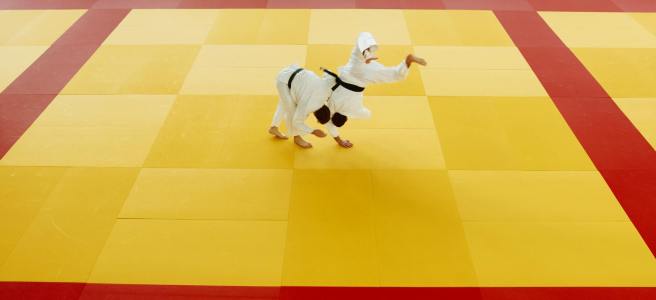
The following is an excerpt of an interview conducted for the upcoming Takahiko Ishikawa: Judo’s Quiet Master, which recounts the life, times, and impact of Ishikawa on East Coast Judo in the United States. Lou Moyerman retells some of his memories establishing the Liberty Bell Judo Classic and a visit from Ishikawa.
Lou Moyerman began training in judo under Helen Foos as a young teenager, moving to Ishikawa’s dojo by the time he was in high school. He founded to Temple Judo Club while there and later competed and coached on both the national and international stages. In 1988, Moyerman, along with Joe Condello, founded the Liberty Bell Judo Classic tournament, which is now considered a large national tournament for all judoka.
MAYTT: Tell us about how you created the Liberty Bell Judo Classic.
LM: Joe Condello and I used to run judo tournaments – little ones here, little ones there. One day, we sat down, and I said to the guys, “I really like to do something different. I’d like to promote a tournament called Liberty Bell Judo. We would give out Liberty Bells as rewards instead of medals to represent the city here.” It was the goal to make it a regional-type tournament. Everybody bought into it, and we started it in 1988. We held it at the George Washington High School for a couple of years, since I taught PE there, I had some connections there to help get the school for the tournament. The first year – we did it in June – we had 102 people in the tournament. I thought we would never survive. We had somebody sponsor us for a couple of years, that helped. By the fifth or sixth year, we were having a couple hundred people and it kept growing. We added different venues; we moved to Holy Family University; we moved to Lincoln High School. I was doing a lot of USA Judo then, so I was all over the country and all over the world. We had kids that were competing for us, but I was the manager with the teams, so I would promote the people outside the US and people inside the US. And it just kept blossoming. The largest number we had was 890, and that was when we didn’t let people fight in two divisions. Now, with people fighting in two or three divisions, numbers are a little high too, but that’s okay. That’s the way things are now. So, for four years in a row, we had over 700 people and one year we had 890.
People were looking for good competitions to go and compete in, and every year it would get harder and harder, almost as fierce as a competition at our nationals at times. But we kept promoting it and the only thing we could do was make it better each time – sit down after each year and ask yourself, what did we do right or wrong; what do we need to do? People said that we needed to get tatami mats and we ended up buying tatami mats. People said to try this system, and we tried that. People said we should try this; we just kept trying to make sure we improved our product, so to speak, the competition each year that people would come. That was the whole idea of it.
Instead of becoming a regional tournament, we became international and highly national and probably one of the most prestigious tournaments in the country, in terms of numbers. If you won the Liberty Bell, it was like you won any other tournament you could fight in in the country. It turned out to be really neat. I won’t lie to anybody, we made money, but we, I’d say, put all that money back into judo: if we needed new mats, we bought it. Since Joe and I had a club, we used to call the tournament the club’s Liberty Bell. It was Susan Oles idea to have a Liberty Bell Judo Club. She said, “You’re at a YMCA but you don’t call yourself the Y Liberty Bell Tournament. Your tournament is Liberty Bell, so make it Judo Liberty Bell.” We did that. When we needed money to pay rent or buy for the clubs, or take kids places, that’s what we used it for. We sent a lot of kids to international tournaments. At times, we helped some of the senior Olympic athletes; we had them as guests so they could raise money to go to what they needed to go to.
We did what we thought what would make our tournament attractive to people, that they would come to a great city, and we tried to promote Philadelphia. A couple of times, we had a few representatives from Philadelphia come from here at the beginning – we had Michael Sweeney for years, and Jason Morris. Later on, we had Brian Olsen, and Surida Chutes. They all came, gave out awards, talked to kids; they gave out autographs, they sold stuff, and helped themselves to the training. I think we just tried to keep everything right and it seemed to work, so we kept at it. Now its Joe’s daughter and my son running it. And hopefully they get to have it this year [2022]; they have it planned. Hopefully things will get better so they can have it this year, because we miss having it. It was a judo happening – it really was. We’ve had people from California, Florida, Colorado, and the Training Center Team came for years; Canada really uplifted their judo when Quebec started bringing in busloads of judoka – two or three buses of kids one year. All teenagers and upcoming athletes that would come down. They liked it because they could fight Saturday with the kids and Sunday with the adults; they go home with eight, ten, or twelve matches in two days, which is like great. That’s how you get better at judo – you compete. If you want to be a competitor, you have to compete. You have to learn what you’re doing right or wrong. Liberty Bell offered that – if somebody fights Saturday and Sunday, they were guaranteed four matches a piece. Some tournaments, you’re lucky if you have a match. That’s why people came.
We were very hospitable to the people that came. We tried to run the tournament for the athletes, not for our ego. That was our biggest things when we started it. This tournament was for the athletes so we tried to run it so effective so that they could come in and only worry about fighting. We did the match numbers for them. We provided whatever we needed to provide for them. We were up all night doing that, but that didn’t matter, and we didn’t care.
I think Ishikawa was very proud of us doing that. During one of the first four or five years, we invited him. I asked Joe if Ishikawa would come if he was invited, because Ishikawa was in Virginia Beach still. Joe said he didn’t know because he wasn’t doing much. Now, Joe moved to Virginia to stay with Ishikawa when he opened a dojo down there. Joe and Ishikawa were very close. I said to Joe, “Well, you’re closer to him than I am. Why don’t you ask him to come up? We can give him some money. We can hand him an envelope with a bunch of money in it because it’s to pay him back from us to him.” We wanted him to be honored there.
After a little bit of him saying no and us asking a few more times, he said that he would come. He was going to go somewhere and stop in Philadelphia. So, he came to the tournament, and we stopped the tournament when he got there. He sat down at the head table, and we introduced him to everybody and got a tremendous around of applause. It was great. We were so happy. Then we sat down with him; we were just talking with him. I told Joe to give Ishikawa the money, but he said for me to give him the money. [Laughs] We went back and forth on this until finally we both say, “Sensei, this is for you.” And we hand him the envelope. He shakes his head, “Oh no, no, no, no. You don’t give me anything.” “Sensei, no. We want to give you something. This is so important to us; this is us saying thank you.” “No. I don’t want it.”
So, we badgered him for just a little bit longer and he finally said, “Okay. Okay. I’ll take it.” He takes the envelope, and he looks at Joe and I and says, “See? I took the envelope; it’s mine.” He threw it on the table and said, “I give it back to you now. It’s yours.” We were both speechless because we didn’t know what to say to him; he got us. Then he said he had to go. We thanked him, put the money back in our pockets, and we looked at each other like he got us and there was nothing we could do about it. That’s the way he was. We were speechless. We didn’t know what to say for a while then we just laughed, because that’s all we could do. [Laughs] I think that was the last time we saw him.
Find out more about Moyerman, Ishikawa, and more in Takahiko Ishikawa: Judo’s Quiet Master!


 Martial Arts of Yesterday, Today and Tomorrow