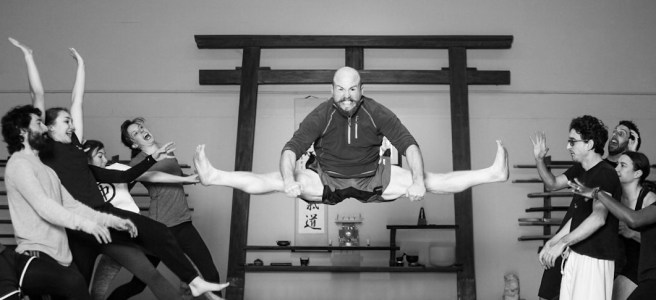
After being told that people who train aikido could use their spiritual ability to stop people from hitting them with sticks, Christopher Hein was intrigued, but could not find a dojo until 1998. He threw himself into the training, becoming uchi deshi at Aikido of Fresno and a black belt. With a history of fighting, Hein experienced a bar fight where aikido did not manifest itself. He went to on train in Brazilian Jiu-Jitsu Mixed Martial Arts, historical stick fighting, and other martial arts until those experiences brought him back to further research aikido. Today, Hein took some time to talk about that journey from aikido and back again, some of his discoveries of the aikido, and the future of martial arts in the United States. All images provided by Christopher Hein. This is the second part of a two part interview. Read the first part here.
MAYTT: That is an interesting way to think about that. So, it seems like you want to involve a sense or a level of critical thinking in your students. Is that correct to assume from what you just explained?

CH: Yes. There’s a bunch of stuff going on here, but the critical thinking aspect is what I spent the bulk of my time working on. To me, the critical thinking part was the most important part for a long time because until we can think critically about what we are seeing, we don’t understand what we are training. And if we don’t understand what we are training, how can we expect to apply it? For example, if you see sankyo, and you didn’t know what it is, you may abstractly say, “Well, it’s a way to twist someone’s wrist. That hurts and maybe you could bring them down to the ground.” But why take someone to the ground by the wrist?
So, to me, the critical thinking aspect is really important when you realize that it’s a clearing method or a disarming method and because due to a series of problems, that could be a take down.
This is to your first question, “Well, am I actually doing aikido now?” I might be teaching another martial arts system that has a lot in common with aikido, but it’s not actually aikido anymore. So, to me, the critical thinking aspect is what is really important. For myself, now, I think I understand what aikido is and now the question is: “How do I better deliver that to my students?”
MAYTT: In 2011, you became the dojo-cho of Aikido of Fresno. What was that experience like when you inherited the dojo?
CH: It was culture shock. The way I got the dojo was interesting. Basically, the instructor was ready to leave, and I was running Central Valley Aikido with Michael Varin. Michael was going to law school at the time, so he wasn’t really interested in taking that on and I said, “Ok. Cool. I’ll take on the dojo.” To me, I thought it was going to be really simple; I just thought, “Well, I’ve been teaching nonstop for years now. This is something I think about all the time. I’m very familiar with aikido and I understand these students.” But I wasn’t ready for the breadth of students I was going to get, because when I was teaching in the garage in my house, that was all people who wanted to get bashed around. They were like me; “I don’t mind getting hit in sometimes or getting whacked with a stick. That’s cool; that’s a part of training.” Then I get into the school where I have a group of kids that I can’t hit in the head with a stick, even if I wanted to. [Laughs] There were old people who didn’t have the physicality to do the kind of training we were doing in my garage either. In the garage, we were literally slamming each other in the wall for hours sometimes. Their [older students] bodies can’t put up with that. So, how do I give this to these people in a way that they can train.

So that was a culture shock to me, and it took a couple of years for me to get my feet under me. Every now and then, I’d have these really good classes where really athletic people show up; cool, I could go at this like I wanted to. And then I’d have this class where it was cricket-cricket because I don’t know how to explain to this sixty-year-old how to move because they don’t know how to move. And I feel like a charlatan as a teacher because why can’t I give you this. I should be able to give you this system because the guy who put this together was an old guy. Well, an athletic old guy, but an old guy. But what was I missing? That took more refinement of me as far as the delivery of the system goes – being able to deliver the system to someone in a way that they can take in beyond just my own perspective of being a tough, fighter guy or whatever the hell I had in mind at that time. But that’s a different aspect. So, it was a culture shock for me to get used to teaching different people and talking to people in different kinds of ways, that took me a while.
MAYTT: After those first few years of refinement, how did that event change your perspective on aikido, if at all?
CH: For me, my interest in martial arts is vast. I like martial arts for lots of different reasons, but the core thing that always brings me back is that I would like to be able to use this system. I feel that, at their core, martial arts systems are to be used. So, the question is, “What are we using it for?” You can look at something like wushu and wushu is built to look pretty and beautiful. You can’t fight with wushu, as people would argue, but you can create a beautiful thing. So, what’s the core of the system? It’s to be used. What’s the core of aikido? Well, it’s to be used. How am I going to use it? Well, I’m going to use it to defend myself, to create accords, to create a situation that isn’t a terrible fight. I understood this for a long time, why can’t I give that to an eight-year-old and why can’t I give that to an eighty-year-old?
So, it started to change my mind about what’s important in the training, and slowly starting to come to terms with the philosophy of aikido; it really is the most important thing, and it lights people on fire. That’s the reason why anyone is really talking about aikido at all these days anymore because there’s this promise that somehow there’s this martial arts system that teaches small and unable people to defend themselves against other people who want to hurt them. Why can’t I teach the small and unable people? Why can I only teach people who are physically capable? Well, there’s a problem. It started to change how I viewed the martial art, making me realize that the system had to be accessible to all people in all ranges. That’s really when I started to clarify for myself that distance and being mentally ahead is the most important set of skills in aikido.
MAYTT: About two years ago, Youtuber Martial Arts Journey, or Rokas, invited you onto his channel for a few videos, conversations, and think-tanks. What were the series of events that led to that guest spot?
CH: When Covid happened, the dojo was out of operation for a while. I honestly didn’t have anything to do. I had been shooting a whole bunch of video stuff in the background of everything else I had going on before covid. I started releasing that video stuff on YouTube. I had students who still wanted to do aikido. So, I started putting up tons of videos. I built a really small following on YouTube during that time period and a lot of people were commenting on my videos. I think YouTube, overall, got a big boost because we were all supposed to stay separated during that time. Rokas said to me that several people had commented on his channel that he should look at my stuff because I was working on a lot of stuff that he had. He contacted me out of the blue, “Would you be interested in talking with me?” I said sure. So, we got together and did a preliminary discussion. He asked if we had the same teacher, because my teacher had moved to Switzerland and that’s where Rokas went to study. So, we had the same teacher. Then we had a lot of common ground, talking about problems we had with that teacher and with aikido – we made a connection. And that led to a lot of talking about aikido back and forth and all those different videos you were talking about.
MAYTT: Was it a positive experience for you?
CH: It was a positive experience for me, yes. Rokas and I are in different places. I don’t want to be disrespectful in saying this, but Rokas is still at a stage that I was at a while ago. I don’t mean mentally, spiritually, or developmentally; I think Rokas is still going through his fighting stage. For me, I’m out of that stage now. I no longer have questions about aikido and fighting, for me, aikido has to do with fighting and all. I think Rokas is still grappling with those issues. It was interesting to talk with him and re-remember a lot of the problems I had; it was a nice experience. I got to talk to someone who was like-minded in the sense that he’s interested in exploring what aikido is and looking to other martial arts to do that.

MAYTT: Do you two still keep in contact?
CH: It’s hit or miss. It’s every now and then. I’ll think of something, or he’ll think of something, and we’ll send emails back and forth. I have several different aikido people that send each other emails when we think about something. Aikido is a small community and then on top of that, aikido people who are willing to experiment with it are an even smaller community. I keep in touch with a fair amount of people here and there who have similar ideas to me.
MAYTT: In addition to that, you have your own YouTube channel, Hein’s Approach to Aikido. How has your content been received from the larger martial arts community?
CH: For me, I spent years talking on the internet talking about my thoughts about aikido and it was mostly trashed by others. The aikido community is full of people who want to do a lot of hero worship. When you start suggesting that one of their heroes didn’t have the full picture, that’s really offensive to people. I’ve been called every name in the book from the aikido community. YouTube, on the other hand, has been a pretty pleasurable because, for the most part, people are like, “Oh, these are interesting ideas. I’ll take them for what they’re worth and take the value out of them from what I can see and move along.” That’s been nice. So as far as how they have received my material, I think it’s been pretty positive – it’s been good.
I think the problem I have with YouTube is that YouTube is really sensationalized so I have a hard time keeping up with that sensationalized nature. While I can do a couple of those videos where it’s fun and I can talk to you about something cool, sporty, and fun, but, at the same time, most of the work that I’m interested in is probably terribly boring to people who are not really interested in aikido. I haven’t really posted anything in a year now because I don’t have anything exciting to tell the YouTube community about right now. I could post videos that they would find boring, but I pulled back into my own community, and I could talk about those things that a smaller community doesn’t find boring and that’s ok.
MAYTT: I see. From your experiences, how would you say aikido relates to other martial arts?
CH: In one sense, aikido is a pretty typical Japanese martial art. It’s very typical. It’s practiced in a recognizable way similar to other Japanese martial arts. It has a lot of the same formalities, practices, and names. In other ways, aikido is wildly different from other martial arts because I think most martial arts are about an attempt to dominate someone else and aikido isn’t about that at all. I think that’s what makes aikido really hard to understand and it took me so long to understand because the whole outlook on the world, in my opinion, is very different from how other martial arts look at it.
It’s very typical; if you’ve done karate and you rolled into an aikido dojo, it doesn’t seem all that weird. There’s some different ceremonies and practices here and there, but it’s pretty normal. However, once you start understanding what’s at the core of aikido, at least as I teach it, it’s actually way different from what most martial arts you would study.
MAYTT: How much contact do you have with other, more traditional styles of aikido? Have they been open to you and your approach or were there some hostilities?
CH: Hardly any, anymore. There are a few aikido schools where I get along with the dojo-cho and they get along with me, and we talk a little bit. But not very much. We don’t hold seminars with other instructors. We don’t have a whole lot of outside contact. I don’t discourage my students; if they want to go and study with someone else, I think that’s fantastic because I think there’s lots of great aikido stuff to see out there. But it’s just that a lot of my practice is upsetting to other aikido schools, so we just don’t commingle that much.
When I first took over Aikido of Fresno, I wanted to be affiliated with the Aikikai – that’s who my rank’s through. I thought, “Oh cool. I’ll be affiliated with the Aikikai.” Then I started talking to people and I just realized how cost-prohibitive it was. Because as a lone dojo-cho who’s taking this on – it’s my sole job – and aikido is way less popular than it was ten years ago when I took it over, I just don’t know how I’m going to come up with the dues and how to host people for seminars, and all the things that you have to do to get into the in-crowd. So, then it was like, “Well, I do my own thing anyway. So, we don’t need to commingle.”
I think this is a real problem in the aikido community; what’s killing aikido at the bottom is the top is sucking up what little resources there are. I think it’s really bad for aikido, honestly.

MAYTT: Final question; how do you think aikido will evolve or degrade over the decade or so?
CH: I think this is a really complicated question. So, I’m going to tell you how I really feel and think so many people would scoff at what I am going to say right now, because it’ll sound ridiculous if you don’t understand where I’m coming from. I think aikido is probably the best available martial art in the world right now, and I think most people would really enjoy practicing it. But there’s so much in the way of getting through to people as to what aikido is, what aikido offers, and what you can get from aikido that it sounds nuts what I’m saying. So, if you come from the sport martial arts community, you would totally laugh at that and say, “Look! Aikido is proven not to work. Why would you study aikido when you could study something like Brazilian Jiu-Jitsu?” There are so many reasons to pick at that, but I really think the core of what aikido offers is fantastic. And I think that if that’s communicated in a way that is clear and not shrouded in a Steven Seagal movie or pretending we’re a badass, break everyone’s wrists kind of guy – if we can get away from that, then I think people could really appreciate aikido. I’m saying if that can happen; I don’t really know how it’s going to happen right now, but aikido could really flourish. I think it could be on the next wave of martial arts that could get popular.
However, I think all martial arts are really headed into decline, as far as what we think of as martial arts. I think that the whole culture is built on a lot of crazy stuff that happened to lock up and sink together. You have the whole soldiers returning from World War II, and World War II created a lot of mystique over here about the Japanese soldiers having these special methods that they used, and they have these swords that can cut through rifles, and they have these secret techniques. And a lot of soldiers being there and being entranced by the culture, saying that the Japanese stuff is fantastic and bringing it here saying that there are these mystical arts. With that idea coming and mixing with new age movements and the 1980s, and Bruce Lee, and Elvis Presley doing karate, and Ed Parker. All of a sudden Americans are like, “Whoa! Martial arts are this cool, fantastic way to learn how to defend yourself. And that’s super awesome!” That slowly morphed further into the creation of Mixed Martial Arts and Brazilian Jiu-Jitsu being the lead martial art in the beginning. Brazilian Jiu-Jitsu uniforms and surrounding culture looked like a traditional martial art, so it matches up with what everyone at the time thought martial arts should look like, but it’s from Brazil. And people say, “Oh, it really works! They can beat up a big guy with it, so this stuff is real!”
Now this is all starting to change inside of MMA. There are lots of people saying, “Well, there’s some good stuff in Brazilian Jiu-Jitsu, but it’s not the best foundation. Maybe wrestling really is the best foundation.” It’s [MMA] really just a sport. So then, you start separating martial arts culture from sports; sports actually work and martial arts culture doesn’t really work. So, there’s this evolution happening, and I think Brazilian Jiu-Jitsu is the last holdout of this previous thing that existed. And I think that once the public gets disillusioned with that, which I think is coming soon, then we just might lose this idea of martial arts that we have altogether. There might just be practices that people do – they don’t really come under this term martial arts we’ve had forever. I think it’s starting to unravel.
Where does aikido stand? My question is where does anything stand in martial arts? I think that the whole thing is falling apart now. It’ll be interesting to see what happens, but I think we’ve played a lot of it out and it’s going to be hard to hold it together. Some polarizing martial arts figure or martial arts system is going to have to arise to bring it all back into solidity.
Something that helped put some things into perspective was that I had a Japanese girlfriend for a long time. She said one day, “Hey, you white people really like martial arts, huh?
“Yeah, Japanese people like martial arts too.”
“No, not really.”
“What do you mean not really? Judo’s like super huge and kendo is super huge.”
“Yeah, that’s things that people do for business, so they can make business partners and get a job. But they don’t like it how you guys like it.”
“What do you mean like ‘us guys like it’?”
“You want to practice old stuff in old clothes.”
“Yeah, so do Japanese people.”
“Not normal Japanese people.”

Through talking to her, I realized that she saw traditional martial arts like civil war reenactment is to us. People put on old clothes and run around in a park and they pretend to shoot at each other, and they reenact Gettysburg or something. I don’t participate in that community, but I understand the stigma that comes with that. To me, martial arts were always cool because I’m from here and here we have it in the movies, and badass movie guys do martial arts. That’s what I’m doing; I’m doing badass movie guy stuff. To her, “No! Cool people are athletes, not martial artists.
Seeing it through her eyes really woke me up and made me go, “Oh, yeah, this is what is really going on.” I think as the image of martial arts in popular media starts to get more and more tarnished, which I think Brazilian Jiu-Jitsu is the last vestige of reasonableness with that, it just starts to fall apart and look weirder and weirder to people.
I really think that the HEMA community – this is how I put it into perspective. I really like the HEMA community; I think they’re really cool. I’ve studied historical martial arts and I teach some. I think what HEMA is attempting to do – and I think this is a possibility – is that they’re trying to do the same thing that classical music does. If you look at classical music, they’re playing only old pieces of music – they’re not contemporary dress anachronistically, meaning that they don’t go to a concert wearing baroque clothing or something. No one does that. They wear formal clothing that looks nice and they’re playing classical instruments that are well-crafted and amazing instruments. Now they look old, but they’re well-crafted and thought about, so there’s a craftsmanship and a quality that’s put into classical music. I believe that’s what the HEMA community is trying to foster; “Yeah, we look at old stuff but we’re not trying to be old.” So, HEMA equipment is really amazing – it’s amazing equipment for sword fighting. It may seem silly, but the swords are well-made, and the equipment is well-made, and it’s built towards being modern. If we were to pull that up into the modern era, how would it look? I believe that the HEMA community is trying to make that thing. I think there can be a classical approach to that, but that’s very different from someone who wants to put on some greaves and do some weird ass old shit that seems stale and weird to everybody outside of a Renaissance Faire.
MAYTT: Thank you again for taking the time to talk with us, Hein Sensei!
CE: Thank you for having me!
This is the second part of a two part interview. Read the first part here.
To learn more about aikido and its history in America, click here.


 Martial Arts of Yesterday, Today and Tomorrow