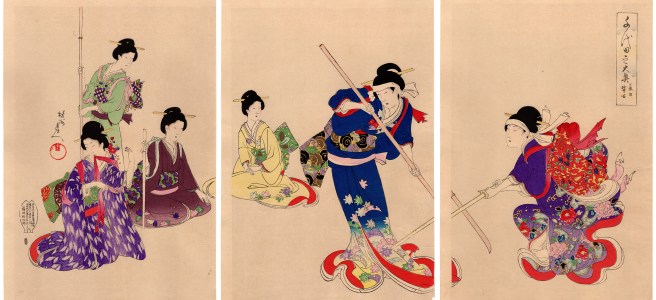
Ellery Engala first started wielding the sword, both in kendo and in iaido, before finding and enrolling himself into his first naginata class. When he did in 2001, Engala began to learn from Sachiko Yamauchi Prough, who was instrumental in establishing both the Canadian Naginata Federation and the East Coast Naginata Federation. When she passed in 2012, Engala became the head of Nichibukan Dojo and has continued to keep her legacy alive. Today, Engala talks about naginata in the United States, its history, and Yamauchi’s legacy.
Martial Arts of Yesterday, Today, and Tomorrow: Welcome and thank you for joining us Engala Sensei! We look forward to learning more about naginata!
Ellery Engala: Thank you for having me and look forward to our conversation.
MAYTT: How and when did you first come to learn naginata? What was it about the Japanese polearm rather than the katana or an unarmed Japanese martial art?
EE: I believe I started in 2001. It actually took me a year. I was first introduced in around 2000 in fall. I believe it was September of 2000. I’d say a few months before that, I was introduced to it during kendo. I actually was always curious about naginata. When I was taking kendo, I asked my late sensei, “Do you know anything about naginata? Do you know anybody that teaches it?” because the only thing I saw was in New England. He said, “No, it’s right here in New Jersey. In fact, it’s in your town, Jersey City.” I was surprised. “If you come next weekend, they’re here to do an Isshu Jiai, a demo.” Then I saw it and I pretty much fell in love with the graceful movements – very elegant. They did an Isshu Jiai, which was kendo versus naginata, and I was completely in awe of how fast and swift it was, and yet you got this long weapon against this mighty sword, so to speak. And it was able to best one of our best kendoka.
So, it took me a year after that to actually to attend a seminar. Actually, I didn’t realize that it was a Friday night class, but everybody who was in the seminar, which was that Saturday and Sunday, was attending the Friday night class, and I thought that was the entire group. In fact, it was the entire east coast. Because at the time, the dojo was part of the East Coast Naginata Federation (ECNF).
So, it took me a year, again, to actually join up, and that was 2001. So, from 1999 to 2000, to 2001. So that was my timespan.
MAYTT: So, you first started kendo and then moved over to naginata?
EE: I was taking them concurrently. At the time, I was taking both concurrently in 2001. Basically, I didn’t miss a practice. Practices were Friday night and Saturday noon in New York at the time, when we had a dojo in New York. Don’t have that anymore in New York; all the dojos are here in New Jersey, Jersey City, and Hoboken rather.
MAYTT: As you were doing both arts concurrently, do you see any overlap in movements, strikes, or anything of that nature?
EE: The only overlap is actually the strikes to the wrist and to the head, and the throat – that’s kote, men, and tsuki. Those are the strikes scored by the naginata and also by the shinai in kendo. As well as do, which is the sides of the waist, or the abdomen, which is protected by the do, which is the breastplate. Both gears are related to kendo. The men, the helmet, and breastplate, the tare, the waist cards, and the kote is the only thing that is different, which is instead of a mitt, it is actually three-fingered. That allows for easy switch of hands and rotation of the weapon around you. That’s a big crossover. But other than that, the stances are complexly different. In kendo, you’re square with your opponent; you’re standing straight on them. In naginata, you are standing in what we call hanmi, in a sideways stance.
MAYTT: How would you describe the type of training you experienced when you first began learning naginata? How have you seen naginata training change or evolve as time went on?
EE: Well, going from kendo to naginata, it’s a much more difficult transition for me because of the stance. And the weapon itself, if you’re not familiar with it, can feel very cumbersome. It looks very smooth and elegant, but that’s by people who have already been practicing. So, that’s one of the biggest obstacles to get over is just that. And in kendo, it’s highly aerobic, not to say that naginata can’t be aerobic, but naginata is like any weapon, it economizes motions. So, you’re making the least amount of effort to get the maximum gain with the weapon. That’s the biggest difference between naginata and kendo.
If you think about it, naginata, for all intents and purposes, is a sword art, really. Whereas kendo, the sword handle, the tsuka, is actually short. If you were to extend that to about a meter and a half, close to two meters, and then you put the bamboo blade on the end of that, it’s the sword handle except that it’s been elongated into this pole – this oval shaped pole. And you have to hold it from the side of your body rather than the side of your body.
The training itself, it has stayed the same. Many of us, now that I’m an instructor, maintain that, especially on the classical end of things to maintain the budo, the martial aspect of the naginata. It’s not so much the competition because our philosophy basically maintains the martial discipline of respecting your opponent and not back-talking. It’s in the same manner as kendo, since it’s a close cousin to kendo, so to speak, since it’s close in the same vein with reiho, etiquette, and form.
MAYTT: I see. Nichibukan Naginata Dojo teaches two different forms of naginata: Atarashii Naginata and Tendo-ryu Naginata-jutsu. Could you explain the differences between these two forms and how do each form complement each other in training?
EE: Okay. Atarashii Naginata, otherwise known as New Naginata, is a much more recent type of naginata, created around the 1940s and 1950s. I’ll have to check on that, but I believe that is correct. The koryu, or the actual budo, martial art of Tendo-ryu is basically done with a kata naginata, which is an all-white oak form of the naginata. In fact, it’s in the shape and it has a tsuba, or a sword guard, on it as well. The Atarashii Naginata is slightly lighter – it’s got an attached bamboo blade to it for competition, and the white oak shaft is slightly lighter. Whereas the kata naginata, or the Tendo-ryu Naginata – which we also use to Zen Nihon Naginata – is much heavier and we actually view that as the closest analog to the real naginata.
Tendo-ryu is best taught to people who had reached their first black belt, which is shodan, in naginata because you have established the understanding of forms and distance. The training and teaching are very careful because, unlike the bamboo blade on the Atarashii Naginata, the all-wood naginata will not bend if you get struck with it. So, there is much care given to that. That’s the main difference between the two martial arts.
You can also find a difference in the movements and in the katas, which are specifically made – in fact, several of the katas are against a sword. And that’s what its main purpose was to teach, actually. One of the main purposes of teaching Tendo-ryu is naginata versus sword.
For more advanced students or practitioners, the two forms actually complement each other. It makes you understand the actual martial discipline of the weapon. You gain more understanding and respect for the weapon by studying both of them because, for example, you’re up against a sword. And so, you start to understand, “Ok, these are all the points under which the application of the koryu or the actual jutsu of the weapon.” You know where to cut, sever the femoral, whether it’s in the leg or underneath the armpit, and how to correctly cut across the abdomen. I know it sounds pretty gruesome, but this is a martial art after all, and this is the actual martial art for how this weapon would be employed against a sword. There are other naginata in which it is naginata versus naginata, and that’s, I believe, also covered in Tendo-ryu. I haven’t gotten that far into it, but many of my colleagues that have been practicing much longer than I have and have much more advanced understanding have gotten even further to that.
MAYTT: Who was your first naginata instructor?
EE: My first naginata instructor that I met back in my kendo days when she appeared there was Sachiko Yamauchi Prough, as we affectionally call her, Yamauchi Sensei. She was married to John Prough, who was also my iaido sensei. In fact, a couple years after naginata, I concurrently took three martial arts: kendo, naginata, and iaido. And so, after four or five years, I had to drop one of those martial arts, which was kendo, because it was getting too much for me and too much for my time.
In 2007, I reached nidan in iaido. I had to stop taking iaido because that was taking up too much of my time as the years went on. So, naginata became the main focus by then.
But Yamauchi Sensei was a phenomenon of her times. She was, at sixteen years old, shodan and back in 1996, she was the youngest to be promoted to the current rank of kyoshi, which I would say is seventh dan in naginata, or senior instructor. she also was very impressive; she won many tournaments – record tournaments – in Japan, including national tournaments, in high school, college, and afterwards. She also got to yondan in iaido, in Muso Shinden-ryu. She got that far before she passed away of a stroke four days after New Year’s in 2012. She was fifty-two at the time. And I believe in 1999, she married John Prough, who was the iaido instructor here – the late John Prough. He passed away two years after she did in 2013. He was our iaido instructor here who founded the Japanese Swordsmanship Society, under which Nichibukan is under.
We hold her very dear to our hearts. Unless my students ask me, I don’t usually mention her name because her teaching was, when you’re the instructor, you’re the instructor, not her. [Laughs] I eventually understood what she was talking about after I had to take over.
MAYTT: Where does her husband, John Prough, come into bringing naginata to America?
EE: Both John and Yamauchi Sensei, martial arts were their lives. To put things into perspective, since she was married to him, she became the president of the US Naginata Federation (USNF). She, through senior naginata members of the federation, helped established the Canadian Naginata Federation as well. The founding of naginata in Canada was a very big thing for East Coast Naginata Federation, as she was one of four members responsible to actually jumpstarting Canada. She became the instructor of a high school naginata club at Kearny High School for a short time, as well as mentored the development of naginata at Mount Holyoke College. Those students at Mount Holyoke College are actually my students now. From there, she passed away, it came down to us in East Coast Naginata Federation to start promoting her legacy. As I said, she’s very well remembered by me. I don’t mention her much unless somebody asks about her. That’s her history here in the United States, however brief it was. I would have to say it was from 1999 to 2012.
John Prough passed away from Parkinson’s. He was a fantastic iaido instructor because he walked around with a cane, but when it came to teaching iaido, he was like Yoda. He dropped the cane and he’d go to town. That was an amazing thing. He was an amazing instructor too. In fact, another colleague of mine in iaido was a double amputee, John Prough Sensei was able to teach him who to draw and sheath a short sword – a kodachi – with one hand. In fact, he became a role model, if not an inspiration during iaido seminars, because people would be completely amazed at this guy, without even looking, able to sheath his sword quietly, and draw it quietly. I’m still amazed at how he does it. It was a very monumental moment in my life as well as his.
MAYTT: I can see how that would be. Could you give me a little more background on Prough?
EE: John Prough Sensei was an engineer. He worked for several companies, especially us government. I believe he was also active in certain projects which I was a little amazed by, in the Skunk Works – they produced systems like the SR-71 Blackbird, upon which he worked on. And he worked on a few others, which I don’t remember, and I think he kept that secret. [Laughs] that was one of his pride and joys, actually being a part of that team. He became a martial artist. He was a very good judoka and then he became a sensei for Muso Shinden-Ryu iaido. I don’t have anything else here that would help you know more about his background other than that he was an amazing sensei, married to another amazing sensei. He spoke his mind and he taught also the koryu version of iaido, which was amazing and deadly to have him teach us certain techniques. Again, you learn a much greater respect for what goes into learning weapons and this type of weaponry, the martial arts, and the aspects of it, and not look at it in any way than it is a tool, and it is something that you respect.
MAYTT: What was Yamauchi like as an instructor?
EE: Oh boy. To me, she was my drill instructor. Because I was the most senior, I would have to say that I took the brunt of all of the corrections – and she meant it in a loving way, I should hope. She was very strict. At times, she could be very loud with you. She was what you would call a classical Japanese sensei, without the corporal punishment, of course. [Laughs] But she was very strict, to the point where you don’t do anything unless she says so. And if somebody screwed up in class, you were in big trouble because it was taken out on you. That was her approach to training. I don’t do that with my students. You grew a thick skin, so to speak. And that became more and more important, not only in the dojo but out in the real world, so those were really good lessons.
She also, because she had classical training in Japan and I’m sure her sensei were just as strict with her, trained on the importance of understanding that this is a weapon. Once you move into using the kata naginata, which is Zen Nihon – not a koryu, but it is related – she made us understand that this is how the weapon is employed and this is how you respect it. In fact, it was no different was well when I was learning iaido because you’re dealing with a bladed instrument there. It’s fascinating how easy it was to transfer over to when I got my first gun, when I go out to the range, when I go out hunting. How you treat the weapon there is no different how you treat the weapon here. It was a very eye-opening, if not humbling, experience.
So, it’s the person behind the weapon that makes the difference, so to speak. I’m not sure if that makes sense in how you portray yourself as an instructor or a student or as well as a martial artist.
MAYTT: Speaking of influencers, who else would you consider as a disseminator of naginata in America?
EE: That’s easy. There are two that actually come up and they’re on the West Coast. One is Helen Nakano Sensei and the other one is Miyako Tanaka Sensei. Helen Nakano Sensei is the founder of the Southern California Naginata Federation and Miyako Tanaka Sensei is the founder of the Northern California Naginata Federation.
They are very strong influencers, and their legacy students are now teachers in their own right. Tanaka sensei has since passed away from pancreatic cancer in 2014, I believe. It was just horrible to lose her. And if you have seen anybody suffer from cancer, it is not a pretty sight. She was a fantastic instructor as well. I loved her because she reminded me of one of my favorite aunts. She’s a very good teacher.
They were very big influencers. Those were the three, actually – including Yamauchi Sensei – in the United States, and still are, with Nakano Sensei being the last of the trio. It was Nakano, Tanaka, and Yamauchi.
MAYTT: Could you tell us more about the history of East Coast Naginata Federation?
EE: East Coast Naginata Federation was founded in 1996 by Raymond Sosnowski and Fran Vall. They started in 1996, as I recall. They started very small. In fact, Yamauchi Sensei was one of the ones recommended to Sosnowski and Vall to reach out regarding assistance with the federation. She helped as a technical instructor to get them up to speed. And she helped grow East Coast Naginata Federation. For a period of time it grew, and then it contracted – that’s the way it is cyclically.
Eventually, there was a break away back in 2006 when this dojo broke away and became the Greater New York Naginata Federation for other reasons. After Yamauchi Sensei passed away, I brought it back to East Coast Naginata Federation – my dojo. And as a result, Natalia followed suit, and so did my students, which are now in Puerto Rico. In fact, they came to visit me in 2013 and they wanted to start a naginata dojo in Puerto Rico. So, they came up here to learn at every seminar. Eventually they formed their section in Puerto Rico. So those are my students. They too followed suit with me to help grow East Coast Naginata Federation.
Like I said, it shrunk down, I think to about five members. Now, after I went from Greater New York back to East Coast Naginata Federation, we grow from thirty. Now, we are up to about sixty-two members from Massachusetts to New Jersey to Virginia, Florida, and Puerto Rico. So, we’ve come a long way.
We do our best to teach martial arts. Obviously, we like to teach the fun part, which is the sparring, but in the end, the education is more important and is the basis to all that. That’s what the students ask for and that’s also part of our curriculum that we teach.
MAYTT: How did the United States Naginata Federation come about as well?
EE: I’m a little fuzzing with the history of it. Much of it, I believe, is on the website. I believe it was formed in 1992. At the time, it also included the Hawaii Naginata Federation, which at the turn of the century, broke away and didn’t want to have anything to do with the USNF for reasons I don’t know. It also comprised of the Hawaiian naginata federation as it grew, but it started out in southern California and norther California and from there, it grew to east coast naginata federation. As the years went on into the 2000s, it started south Atlantic naginata federation and the pacific northwest naginata federation. And then Great New York split from ECNF and that he us up to – oh! I forget Rocky Mountain! That was up to seven federations. Now we are down to six. I’d say that the 2000s were a very fertile time of growth for naginata.
USNF is a national federation that comprises all those regional federations and they send representatives every two years to discuss what most corporations do when they go to a board meeting, which is when the next tournaments are, the funding, etc. It’s a very well-organized machine when it comes to the martial arts and keeping insurance, and funding going for all of the federations.
MAYTT: From that, how have these federations helped raise awareness of naginata to the American public?
EE: That’s a good question. Each region does their best to grow it. Some regions have worked through colleges because some of the students either take grad studies or are students in college that want to start clubs there. That’s how they normally influence it. It’s very difficult to actually – whether its kendo or naginata; kendo is much easier but naginata, it’s very difficult because it requires more space due to the weapon being two-and-a-half meters long. You need high ceilings and a lot of space to practice naginata. And to promote it, some of the regions go to the Sakura Matsuri festivals, or Cherry Blossom Festivals. We on the East Coast have found it to be actually not worth doing anymore because we never get any recruits from those festivals. It’s more of a show to people who attended those events than it is something that makes people go, “Oh yeah! I want to join that!” We either keep it to visiting schools doing demos or, in some instances, actually going to conventions, such as Comic Con. We actually make a lot more students that way, in some instances, due to people’s interest in that frontier. We’re doing more now this year [2023] with high schools – doing demos there – since we do some of our seminars at high school gymnasiums. We’re hoping to, this year [2023], do more in that regard.
The most that they do is through Instagram, through social media – that’s how they raise awareness. They try their best to do it that way. I have a love-hate relationship when it comes to that sort of thing with certain social media, as to not make it too comical or make it that is disrespectful to the art. I’ve seen a lot of crazy things on TikTok and Instagram, especially the videos where guys are twirling katanas all over the place and there’s no way you can do that without your wrist breaking. And you know that the swords aren’t completely real at all. That’s the only thing I have with that, but if it’s done tastefully then it becomes a vehicle to get the word out. There is still a leeriness among some Americans using weapons, whether they are made out of wood or bamboo. But I think that is really bad media and also Hollywood perpetuating the negativity of that. I leave it up to my students to do social media on Facebook, Discord, and Instagram. I’m not sure if it’s the same in the other arts, if it’s karate or iaido, but as far as I know, that’s how it’s always been maintained recently.
Social media is very difficult and that’s why I take it with a grain of salt because social media is a difficult thing. I’ve heard people say, “We can do things through TikTok.” And the things I’ve seen on the thirty-second TikToks on martial arts don’t look good – it’s almost comic. It’s not a very good way of actually promoting something that has certain complexities to it. I’m sure you’ve also experienced that with your martial arts as well.
It’s very hard to promote naginata because – not to knock this generation – this generation is glued to their screens. A lot of it is that they enjoy the virtual platform. Trying to get people to get out there and exercise is very difficult. That’s something that I believe as a country we should go back to, which is Phys Ed because I can speak about my own nephews and about how they’re glued to the computer screen or the gaming screen. It’s easier for them to fight virtually than it is to actually pick something up and move with it. [Laughs] I’ve seen this happen with people coming in to iai under the iai sensei here. The moment you give them a katana sword, they don’t realize how heavy it is, in terms of its weight. The very weight of it, with one arm, you have to cut across with first, and then two hands to cut down. Eventually, they’re not used to sweating. It’s sort of interesting to see that and we sort of have a three-month probationary period among the instructors, whether or not they stay or they go. That’s sort of our gauge as senseis.
MAYTT: On that regard, I spoke with a battodo instructor, and he basically said the same thing with giving them a sword and doing the art does not align with whatever their fantasy is of the sword, let alone the betting on new student retention.
EE: Here’s a close analog. I told you about firearms; people think it’s very easy to fire a pistol or to fire a rifle. Until you get behind that thing, you don’t realize the recoil or that you lose aim after the first shot if you don’t have a strong arm. Like the sword, it’s not an easy weapon if you’re not used to it. [Laughs] Or you don’t practice it. A lot of people want to go the easy way, shooting a rifle is like shooting a BB gun. No! [Laughs] The same goes with the shotgun. When I go duck hunting, it is quite interesting to start to understand that this is great – this is the crossover. the way people perceive things with what they see on tv and in fantasy is not the same in reality. We all have a laugh about that. [Laughs]
MAYTT: Do naginata schools have much interaction with iaido or kendo schools? Do you feel that naginata practitioners can learn some form both iaidoka and kenshi and vice versa?
EE: My dojo does. There are several dojos because a few naginataka that have done a crossover or that still do kendo because of the close relation in armor and because of striking and all that stuff. Were very closely related. In fact, there are times where we share dojos. Kendo goes first or naginata goes first, and then after their hour is done, kendo comes in or vice versa. And sometimes they ask if we can do an Isshu Jiai – kendo versus naginata. You have to be third dan and above to do that because it’s not recommended if you’re under sandan to spar with a kendoka. It’s a safety factor.
We are very closely related and there is a lot of interaction between the two groups and the two groups are aware of each other. And in fact, my students in naginata down in Puerto Rico are kendoka too. They operate out of the same dojo – same space.
MAYTT: So, what you are saying is that there is this underlying camaraderie between kendo and naginata.
EE: Yes, there is. Yup. There is. And one of my students here – actually, I’ll see him tomorrow – he’s a kendoka. So, I like it because he’s already prepackaged. He has most of his armor: kote and tsuniate, which is the greaves that are on your legs, which is where you score most of your points. He brings that fire from kendo to naginata, which he understands seme – he understands pressure. That is the seme and the zanshin, which is very necessary when you’re with any weapon.
MAYTT: Has there been any joint seminars or events between the United States Naginata Federation and the All United States Kendo Federation or with any of the regional federations?
EE: No, no. they’re all kept separate. The USNF does only naginata and whenever we have a regional, it’s a regional seminar. That’s the way it works. Nationals are only once a year. Regionals, concerning my federation, we have it twice. We have it in spring, and we have it in fall. Spring here in Weehawken, New Jersey, and fall down in Manassas Park, Virginia and Hotarukan Dojo.
MAYTT: Final question. With Covid restrictions and mandates behind most Americans, have you seen a resurgence in interest in naginata? How has naginata practice changed since the pandemic?
EE: Yes. For example, in Northern California, they gained – they lost a lot of students but they gained the same number of students back. It was good. They gain ten students; I gained one. [Laughs] But, in terms of resurgence, everything’s back to normal. In terms of resurgence, it all depends on the instructor’s time. For example, the iaido instructor, who happens to be one of my senior students and me, who have time out of our own lives to devote to promoting and teaching. In fact, I leave a lot of that to my senior students. One of my senior students in Yukon, she established a naginata dojo there and they have grown there, which is good. There has been growth as well in Puerto Rico, which is fantastic. And we are still growing and growing still. We’ll probably grow again around the Virginia area after February [2023]. We’ve got our fingers crossed for that. We’re hoping to do more demos. We’re looking into one in Las Vegas, but we’ll see if we can accomplish that. We have to do some more research there.
During the pandemic, we had no problem training outside. We trained, unlike our brethren in the rest of the country where they had much more draconian policies, in the parks, in the parking lots, in the front yards of our relatives that had big yards. We never stopped practicing. That actually kept our numbers steady, rather than shrinking. We used Zoom a lot to keep everybody interested and training. Obviously, virtual environment doesn’t really work, but if you have enough experienced naginataka out there, they can understand how to train certain techniques on their own. That has helped out a lot in maintaining our numbers.
MAYTT: Thank you again for joining us today to talk about naginata!
EE: It was a pleasure.


 Martial Arts of Yesterday, Today and Tomorrow