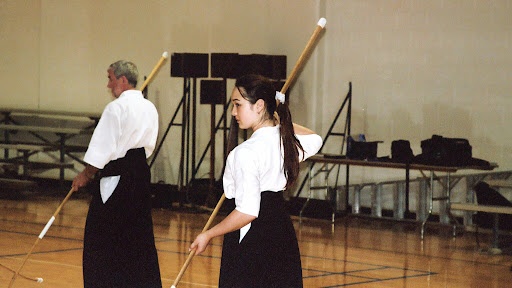
Katie Roche wanted to find out what naginata was as a child after hearing her grandmother talk about her time in the art. After some time and breaking up with her high school boyfriend, she enrolled herself into naginata, studying first under Sachiko Yamauchi. When she relocated for undergraduate studies at Mount Holyoke College and graduate studies Columbia University, she began a naginata club from scratch at both campuses, and currently heads the Columbia University Naginata Club, is the Chief Naginata Instructor at Ken-Zen Institute, and is the President of the Greater New York Naginata Federation. Additionally, she competed three times at the World Naginata Championships, won the United States National Championships six times, and is currently the youngest godan on the East Coast. Today, Roche took some time to talk about her experience at the World Naginata Championships, how she built naginata clubs from scratch, and where naginata took her. All images provided by Katie Roche. This is the second part of a three part interview. Read the first part here and the third part here.
MAYTT: That is an interesting approach. Both the Greater New York Naginata Federation and the United States Naginata Federation teach Atarashii Naginata. To you, what separates this form of naginata from koryu naginata?

KR: Well, it’s a very short answer. Koryu naginata is the pre-World War II naginata, so it’s actually the stuff before the PE version that my grandmother did. If you think of kenjutsu, jiujutsu, or Muso Shinden-ryu, Muso Jikiden Eishin-ryu, where you’re doing older techniques in older forms and there’s no ranking system, the curriculum is a little bit different, the way you learn stuff is different, and there’s a soke, or a “pope” of the ryuha (the style). That’s what Tendo-ryu, Toda-ha Buko-ryu, Jikishinkage-ryu all are; those are all naginata-jutsu, so pre-World War II naginata. So, you’re going to have a soke, you’re going to have a “Tendo-Ryu pope” and that’s it, they’re going to rule the whole thing and you’re not going to have any dan ranks or anything like that. It’s very old school. The techniques are older and there’s no full-contact sparring with armor.
Atarashii naginata – “Atarashii” means new and was formed after World War II. Basically, a lot of teachers got together to try to form this modern, sportified type of budo that would be more suitable for school-aged girls. And that’s what Atarashii Naginata did and that is what the United States Naginata Federation and what Greater New York Naginata Federation (a regional federation under the USNF) practices. We are a regional federation under the national federation. Think of like AUSKF for kendo; the Southern California Kendo Federation is under the All United States Kendo Federation. That’s how we are.
We have ranks, we spar, we have tournaments, but with koryu, there aren’t any tournaments or anything like that. You’re just learning and it’s kind of like an apprenticeship situation.
MAYTT: So, do either the regional or the national federations teach the koryu naginata, or is it just solely Atarashii?
KR: No. Actually, there’s a rule about that. It’s not written in any doctrine in the Federation – the All Japan Federation or the International Federation rules – but there is an unsaid rule that in any Atarashii event, you cannot teach koryu. Atarashii Naginata is composed of a few naginata koryu styles, we took some techniques from Tendo-ryu, techniques from Jikishinkage-ryu, and put them together with a little dash of kendo elements. Some kendo senseis were part of the brainstorming process, which is why we have bogu that’s really similar. Obviously with koryu, with any kind of koryu art, the practitioners that commit themselves to koryu are almost very religious about that koryu. They get into the typical fights with other koryu styles about which one is better – it still exists today with anything, so the custom of not teaching koryu at an atarashii event is followed as a way to prevent these kinds of fights. Koryu is also dying out, as much as people don’t like to hear about it, makes some practitioners feel very sensitive about not having an equal opportunity of recruitment if only one ryuha is practiced at a big atarashii event. Thus, this unsaid practice is a form of courtesy to all koryu. Koryu has to be done at a separate event.
Now, with dojos, individual dojos, they can do what they want. If you have a sensei that does koryu in addition to Atarashii, they could go and do koryu during their classes. They could do anything they want to. But as for official events, sponsored by the federation, they can’t do that.
For example, my sensei did Tendo-ryu. But, sometimes in class, she would have somebody who wanted to do Tendo-ryu and they would do it on the side while I was doing Atarashii. During our seminars – our New York/New Jersey seminars and taikai – there would be no Tendo-ryu learning, for example.

MAYTT: A little bit earlier, you mentioned the All United States Kendo Federation and the like. Has there been any cross-federation training either on the national or regional scale between naginata and kendo?
KR: Not in the United States. Nothing with cross-federation stuff. Sometimes with independent dojos; you would invite them over and maybe have an isshujiai demonstration. Fun fact though, according to my naginata sensei’s husband, he said that originally in Japan – this is back in the 1950s – naginata was part of the kendo federation in Japan, but then the kendo federation booted them out. Supposedly, the reason was because they didn’t want to promote strong women. That’s why jodo and iaido are still under the kendo federation in Japan; that’s also the same here in the United States. The exit from the Japanese kendo federation really hurt naginata in the beginning because they started from zero budget, and they had to do everything from scratch. That’s one of the contributing factors as to why it is so small.
MAYTT: Wow. Talk about setting them up to fail in the long term.
KR: That’s what my sensei’s husband believed and implied.
MAYTT: Also, you are the Vice President [as of 2023, President] of the Greater New York Naginata Federation with the goal of expanding the federation with more dojos and members and for the “federation to become more tech savvy.” How, as Vice President, do you plan to achieve these goals for 2023?
KR: I that the first thing is that you have to really think of it as it’s going to take longer than a year, but that doesn’t mean you can put it on the backburner. I think that’s one thing that they make a mistake about long-term projects. They think, “Oh, because it’s long-term, I can just do it later.” But no. That means it requires a lot of time, for a long amount of time, so you need to start now. What I’ve done in the recent two years, especially during the pandemic, was forced all of us to be more tech savvy in areas we didn’t think would ever go tech savvy. Despite the technology being available, it is hard being able to have naginata resources more accessible. That’s really, I think, a big key in being able to spread any martial art. You need to have the resources and quality resources regularly accessible.
So believe it or not, the funny thing is that my idea for this goal came from something I remembered my tenth-grade biology teacher saying during class when she gave us this class project about needing to invent a new kind of birth control. As tenth graders, we were like, “What? How?” What she said, which stuck to me was, “The key thing you have to remember is that it has to be effective yet easily accessible.” So that formula for a solution that is effective and easily accessible is something that I think of when I try to spread naginata and I think that any kind of martial art, especially one that has a small population probably needs to think about if they want to continue it because that’s what you need.
Again, there’s that whole internet meme that happened a decade ago of the “McDojos.” I don’t know how that became a thing – the strip mall, fake martial arts places. I have to admit, it’s a good business model, I guess, it’s everywhere. While I get how fortunate martial arts practitioners with qualified sensei would want to meme-fy those places, the bottom line is that’s the reality of the average person trying to start martial arts. They will find a McDojo and that’s their only source that they know of that they can go to if they want to train in martial arts. So, the issue now is about quality. I think that one thing that is very hard for naginata is that there’s not that many dojos around the world. Even in Japan, there aren’t that many compared to kendo, for example.

So, what do you do to solve that problem? I have to make the resources – it has to be good resources, easily accessible. What’s something that could provide that? The internet and technology. So that’s what I keep in mind for spreading it. One thing, for example, is being able to have online Zoom classes, also more videos and different mediums to do basic things, more glossaries, more visuals with the techniques, and also virtual promotion exams. For naginata, myself and some of my other students have designed a whole system for virtual promotion exams. Believe it or not, it got accepted by the federation and approved. That was huge in spreading naginata. It’s so challenging to do it because it’s not like karate or some other martial arts where you could just demonstrate a form solo, and somebody looks at you – that’s a little more straightforward with a camera because you’re replacing your human eye with a camera. You can just see the required skills and get someone promoted. But naginata, you always need a partner for most of the stuff. Nevertheless, the people who wanted to start naginata and had no sensei around them found a way to do the exams. They would get their family members or friends to do it with them and they were able to learn the curriculum virtually, and then have that friend or family member be their testing partner when taking a naginata promotion exam online.
That was huge because a big problem, I think, before this technology was available, was that people would have to go in person. They would only be able to test for kyu ranks maybe once a year, if even. This is also assuming that they had money and also the time off to do that from their jobs. If you’re only able to test once a year because circumstances out of your control, that will demotivate you – I think that will demotivate anybody. And even for the most patient person, it’s demotivating because there’s no measurement to progress. Kyu ranks are not supposed to have such a huge wait time, in my opinion, especially if you are training consistently. At least, from my understanding of evaluating kyu ranks, it’s the ability to do basic body control and weapon control; with consistent practice, you should be able to get it within a few months. However, if you do not have any kind of frequent evaluation about your technique during your primary years, which in this case would be shinsas, eventually people will drop out because they do not have consistent guidance to go with their consistent training, nor do they have any external affirmations to keep them motivated. Taking years for getting kyu ranks due to something out of your control and seeing others skip on ahead due to accessible resources will get many to quit. The virtual promotion exams got rid of this long-time problem by giving those isolated beginners a chance to get frequent, measurable progress, and most importantly, gave them the motivation to want to reach high and get those dan ranks to help spread naginata in their areas. The people who have the opportunity to train with a sensei locally, of course have the chance of getting more opportunities to get feedback and evaluations from other sensei because of these promotion exams, which made it a great learning experience for them and motivated them to continue as well. The virtual promotion exams were great.
We had dojos grow everywhere. There’s a group that completely started from nothing – a study group outside of Baltimore, Maryland. Now everybody there, because of virtual promotion exams and because of technology like Zoom, now will have those first three founding members testing for shodan in a month. They all started during the pandemic; they were all beginners. Technology allowed them to advance and that allowed them to continue naginata.
Then, I had somebody approach me because he saw my video in this little group called Budo Cool about iaido. He’s in Mexico City and he wanted to test, but there were no naginata in Mexico. Now, he’s testing for shodan in a month because of technology. His students are able to test – they got ranks, which wouldn’t have happened because Mexico does not have a full testing judge panel composed of three sandan sensei to hold the promotion exams. No one’s going to have the money from a developing federation to pay for the plane ticket for three or more judges and hotels just to go there and test a few people. It’s impossible to start out unless you are given the opportunity. I also reached out to somebody in Korea, and they Zoom into my classes at the dojo every week. All of his students were able to get promoted during the pandemic due to technology and now they can test for shodan in Japan, where that plane ticket is much more affordable compared to flying to Europe or the United States.

That’s a lot of growth.
There is also a study group in Columbus, Ohio and there’s a group in Cambridge, Massachusetts. A lot of dojos grew during the pandemic because of the virtual opportunities. Having easily accessible naginata resources is something that I do care about, because as someone who had to start a club from scratch twice while not having the luxury of resident coach, while also doing all of the teaching and I figuring out everything on my own, on top of having my sensei die when I was just a sandan, for example, I have had my fair share of time of not having the answers in front of me all the time. Yes, I had some opportunities – some compared to others – but I didn’t just have that there all the time. I had to really try to think critically and creatively to find ways to understand correct naginata. There was a lot of time spent on faulty mistakes, which would’ve been minimized had I had access to quality resources. I wouldn’t want others to go through the same thing – that’s a change I wanted to make and why I am big on making easily accessible, quality, naginata resources.
But really, the answer lies in technology now.
Even in my cerebral palsy research, which is what I do in addition to this – I’m publishing a paper now on recreational activity and the direction it’s going in is more towards the virtual. It’s merely due to accessibility and convenience.
MAYTT: That is amazing that your federation has had the chance to grow in the middle of the pandemic no less. I have not talked to other martial artists where they have used technology to the extent you have used it and that would have changed so much for them.
KR: I push for it, mainly for accessibility – that is my big thing. I am about accessibility and quality accessibility. As anybody who does martial arts, a lot of people do budo or a traditional Japanese martial art because of that old charm, and I think that’s one of the appealing things. But it takes a long time to get into the art and for a long time being exposed to the right teachers and the right people to really understand what it is at the core and develop that “sense” to make the right decisions and still fit within that realm, rather than putting their own spin on the interpretations which aren’t quite right. We’ve got a lot of those, and as you can imagine, they disagree with virtual accessibility. I have to deal with some of the “Naginata Conservatives” as I call them, who are completely against virtual and say things along the lines of “it is not tradition,” “Musashi was never in front of the camera,” “You can’t get the spirit of budo from here.” Maybe, it’s not necessarily false but I think that for the beginning, it’s better than zero opportunity and you need that motivation for beginners to keep going so they’re motivated to want to take that extra step and be really dedicated to it. But, in the beginning stages, you have to give a little more to them, in my opinion. But I face that all the time; I fight it all the time, but I’m still dead set on virtual, especially for the beginning stages and accessibility.
I think that for something like this, which isn’t something that’s too terrible, you will still be able to maintain the basic essence of the art through the camera, and it’s therefore not a bad thing to use technology. To be honest, I think it’s harming the art and harming the federation more if you get rid of technology. If we do that, then we’re going to end up like those koryu!
MAYTT: To your knowledge, who would you consider having first brought naginata to the Greater New York region?
KR: Well, it was my sensei’s husband, John Prough. There’s a little bit of a strange thing with that – I’m still trying to figure out the history of naginata in NYC. Apparently, according to my kendo sensei at Ken-Zen Dojo in New York, he said that there was a Japanese lady that did naginata back in the 1980s, but he doesn’t know what happened to her. He described her as a “very feminine lady,” which I find funny because I guess that’s true – naginata people are more feminine in general. But I didn’t know anything else about her and I don’t remember my sensei’s husband mentioning any feminine lady in the 1980s.
According to John, there were these two Japanese people here in NYC back in the 1980’. One was a guy actually and one was a girl. They were here and they were in contact with my sensei’s husband, who did judo at the time, and first learned naginata from them. One of them went back to Australia to study graphic design, and I tried to locate that person with the Australian Naginata Federation, but there was no sign of anything. Then that guy moved back to Tokyo, so I tried to locate him with the help of a hanshi in Japan, but nothing. So, I don’t know who the first official person was who did naginata here in NYC. What I know is that there are three mysterious Japanese people – one of them I’m not sure if it’s the same person.

Then my sensei’s husband, John Prough, an iaido and judo person, was here and learned from them. But I think he was the first person to really try and start something here and gathered those people around, because those Japanese people did not have a dojo, if I’m not mistaken. They just knew John Prough and they trained together. The reason my sensei was able to come into the picture was because he had a study group on White Street in Tribeca at one point, and he was in contact with the United States Naginata Federation (USNF). There were only two teachers at the time, and they were in California. One of them was from Osaka and she moved to the US in California and married somebody. He brought her over and she taught a seminar. I think one year that sensei, originally from Osaka and living in San Francisco, brought my sensei for a seminar in New York. Then, the story goes, John Prough talked about the long-term plan for naginata here in NYC – I guess he wanted to grow it here. He said to that sensei from San Francisco: “Well, I don’t know how to do this because you’re all the way out in California. It’s not feasible to bring you over once a year.” He joked – there is always a truth in a joke – “Maybe I could hijack Yamauchi’s passport and she could just stay in New York and develop naginata.” So then that San Francisco sensei translated it to her, and my sensei said, “No. I’ll do it.” His jaw dropped and basically for a long time, my sensei would stay in New York at his house in separate rooms. She was under a tourist visa, so every three months she would go back to Japan and come back and forth. Eventually they fell in love and got married and that was it.
I’m still trying to figure out the mystery in New York, but that’s what I heard. [Laughs]
MAYTT: That is a lot of hearsay!
KR: There is a lot of hearsay.
This is the second part of a three part interview. Read the first part here and the third part here.


 Martial Arts of Yesterday, Today and Tomorrow