
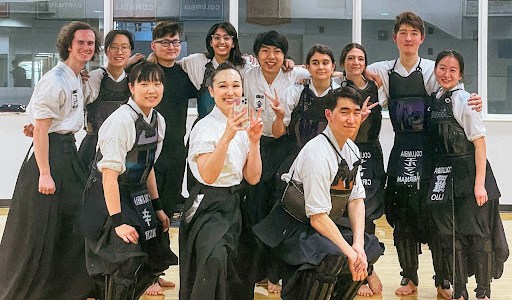
Katie Roche wanted to find out what naginata was as a child after hearing her grandmother talk about her time in the art. After some time and breaking up with her high school boyfriend, she enrolled herself into naginata, studying first under Sachiko Yamauchi. When she relocated for undergraduate studies at Mount Holyoke College and graduate studies Columbia University, she began a naginata club from scratch at both campuses, and currently heads the Columbia University Naginata Club, is the Chief Naginata Instructor at Ken-Zen Institute, and is the President of the Greater New York Naginata Federation. Additionally, she competed three times at the World Naginata Championships, won the United States National Championships six times, and is currently the youngest godan on the East Coast. Today, Roche took some time to talk about her experience at the World Naginata Championships, how she built naginata clubs from scratch, and where naginata took her. All images provided by Katie Roche. This is the first part of a three part interview. Read the second part here.
Martial Arts of Yesterday, Today, and Tomorrow: Welcome and thank you for joining us to talk about your time in naginata, Roche Sensei!
Katie Roche: Thank you for having me today!

MAYTT: Like many of the weapon-based martial arts, they are not the first choices for many Americans. When did you first start training in naginata?
KR: So, the short answer is that I started naginata when I was sixteen years old. I was a Junior going into my senior year in high school.
MAYTT: I see. How did you come to find naginata, since it is not that popular in the States here?
EE: It’s not popular anywhere. [Laughs] To be honest, it’s not that popular in Japan. Well, I first heard the word “naginata” from my maternal grandmother who did it during the [Second World] War – so back in World War II when Japan was being very aggressive with its military operations. The secondary schools – essentially K–12 schools – would all be doing budo, or just martial arts, as their PE classes. Back then, when my grandmother was in middle school, the girls did naginata while the boys did kendo or judo. My grandfather was forced to do kendo. Actually, I think he chose to do kendo over judo, despite him wanting to be a swimmer.
So, she did it during World War II and it was the PE style naginata with a little bit of fascist undertones [Laughs] with the military propaganda, where they’re like, “This is how you kill Americans.” That’s the version she did. But she didn’t talk about that part. She just remembered little parts about it, like the weapon being a little bit shorter than the one I use for modern naginata, for example. And just a little bit of the movements; I think she had a little bit more rounded movements in general.
And that’s where I first heard the word and I just got curious about it, and I looked it up. There used to be this website called martialarts.com – literally martialarts.com. I don’t know if it still exists anymore, but it was a very 1990s style webpage that had no advanced script or anything. It was trying to be this encyclopedia of martial arts and have every single style written up there with the description. Naginata was there and the photo that was there was one of people that looked like people doing kendo except they had long spears. So, I said to myself, “Oh. This is like kendo but with long sticks. This is pretty cool.” I wanted to look for a dojo because I was curious, and I was about eleven years old at the time – sixth grade. However, at that time, my search skills were not as good as now, so I couldn’t find any dojo.

How I got started though – what the catalyst was in doing it – was a few years later – it’s a funny story actually. Probably very different from what you probably usually hear from martial artists in general is I basically was chasing a boy. I’m sure that piqued your interest a little bit but basically, I had a high school boyfriend that I was very much in love with and then we broke up and I was very sad. There’s a saying here that goes: “If you get your heart broken or you go through a breakup, you gotta try something different,” as a way to sort of give yourself self-therapy and also to try to forget about it and move on – beget a new you.
Fun fact, I’m not sure if you know this, but in Japan they say you get a haircut if you have a breakup. But here, it’s different; it’s try something new. “So maybe I should try something new. Let me see if I can try this naginata thing.” This time, I tried the search again and I found a dojo, but the first search hit was actually the US Federation, the national organization. On there, the first thing that was advertised was the fortieth anniversary championships and seminars were open to beginners. I was like, “This is interesting.” I scrolled down and I looked at the location and it was actually in the same hometown of that boyfriend of mine. So I was, “Well, I can sign up for this and maybe I can see him again.” And that was what did it! [Laughs]
So, I signed up for that seminar first and then I found a dojo near here – great! So, I could start it here. That’s what it was, that was the catalyst in starting it.
Why I continued; basically I didn’t think I would get this far in naginata to be honest. I thought that it would be my temporary therapy and then once I got over the guy, then I could move on to whatever. But that’s not what happened at all. I just never got bored. And that’s it. It’s very simple, nothing so deep. I think it’s very simple why people continue something; you don’t get bored, and you just keep going. That’s what happened to me.
So that’s basically how I got started and that was the catalyst.
MAYTT: That is amazing how your self-therapy became something you do on a long-term basis!
KR: Well, I am over him, so I guess it worked! [Laughs] Why am I still doing this therapy if I’m over it? But that was basically the story.
MAYTT: When you began naginata, how would you describe the training you experienced?
KR: I think I know what kind of question you are asking, but, unfortunately, the answer to that question is not quite what you would expect. Basically, I don’t have that story of staying up late in the dojo and getting beat up and washing dishes, doing all of that stuff, and being so hard that I couldn’t do it, no. My sensei was a very good sensei, and I would have to say that she was the best sensei that I ever had. She unfortunately passed away eleven years ago [2012] actually. She was very young; she was fifty-two when she died. She had a brain aneurysm. Nevertheless, she was just very good at what she did; she knew how to teach people based on their natural abilities while factoring in their motivation and their age didn’t matter. Because she knew what she was doing, there was nothing super impossibly difficult, but I wouldn’t say it was super easy either. It was just a perfect kind of level of appropriateness.

But to answer your question about what exactly I did; really, she, I think since the beginning, was very ambitious and because I was young and I think the fact that I was female, given naginata’s long history of being a female martial art and most of the practicing population outside of Japan being mostly male due to martial arts in the West being portrayed as being a male activity, I think that she had a lot of ambition for me very early. She said to me, “You’re going to go to the World Championship in two years.” I said, “What are you on!?!? You know how people train for the Olympics; don’t you have to start as a three-year-old?” She reassured me that I was going to make it and it was going to be fine.
I just did what she said.
Unfortunately, there’s not really much for me to describe. Really, she did do a lot of kata, so that’s what I did – a lot of kata. She didn’t put me in bogu quickly, despite me having a long martial arts background and kendo background. She just had me do a lot of kata. She expected me to learn quickly and to just do it. Those were the early days; just kata and I did what she said. [Laughs] Really, nothing too crazy. And it didn’t feel insanely difficult, but I wouldn’t say it’s easy, like with anything. There was just always this feeling of excitement about something that requires a little bit of brain work to do, and it overall was just fine. I just did it.
MAYTT: How have you noticed the training change or evolve as you continued through the art?

KR: Unfortunately, that’s not such a simple answer, even though it’s a simple question, because I think when people ask how the training changed, the image that somebody has in mind is somebody that has stayed in the same environmental conditions during their whole budo career, since they were a beginner; same sensei, same peers, same dojo, same routine, and same intensity. But for me, unfortunately, it wasn’t so linear, because I went to undergrad out of state, I started my own club, and I was alone. I didn’t have anybody higher ranking. I started everything from scratch and was teaching people. I also studied abroad in Japan for a year where I was at a local dojo. I came back, still did the club, and then I was with my sensei for about one to two years after graduating, and then she died. I didn’t even have a decade of training with her, to be honest. I was mainly, I guess you could say, self-taught and figured things out with little bits of training in Japan. So, I think that’s the first thing I want to say; my background isn’t really that linear or typical. The path goes all over the place and that can kind of affect how I can answer the question.
But given those things and irregularities, I would say that a common thing that people face, regardless of the background, is that most of the training involves perfecting your technique, the physical technique. It’s funny I say this because since I’ve been in this training phase for so long, I think my mind still likes to believe that I’m in that phase and I haven’t fully let go of it yet. A big, important part about the technical training is training how your body works with the naginata. As you get less and less obvious, measurable, visible corrections over time, then it starts to turn into corrections that are more about abstract topics like how your mind is, how you do the technique versus what you’re doing.
One example, if I’m going to give a concrete example is that when you’re testing for sandan, for example, the way that my sensei and others have told me about what sandan looks like is they should all have good tenouchi, very good seme (pressure), you’re able to take good distance (maai), every single strike you do is struck with the correct part of the naginata (monouchi) at a hundred percent accuracy rate, and you can do more offensive waza. So those things you can kind of see visually. While seme is a little bit more of a feeling and abstract, the monouchi accuracy, hitting the target, for example, are measurable and observable. In that way; you can quantify it. You can’t really quantify seme for example.
But then, yondan, the only thing I’ve ever heard from my sensei was, “You should have no bad habits.” The word that she uses is, “kuse” which in Japanese means, “habit,” like if you’re biting your nails or twitching – a bad habit that you cannot control. So, no bad habits in your techniques and she said that all of my strikes had to be sharp. What does “sharp” mean? What does “sharp” look like? It’s kind of hard to imagine and you can’t really get explicit directions to execute that. It’s something that, unfortunately, you figure out on your own with little trial and error moments here and there, and then maybe, it leads to that desired outcome. Because the requirements are more abstract, that does change how you want to focus on your training, especially if you’re trying to focus on outcomes like passing a shinsa.

MAYTT: Who was your first sensei?
KR: Yamauchi Sachiko.
MAYTT: To clarify, was she based in New York or New Jersey?
KR: She’s originally from Japan and then she moved here to the United States. She married an iaido guy who used to do judo. She lived in New Jersey, but it’s still the Greater New York Area, but her dojo was both in Jersey City and in New York, on Broome Street.
MAYTT: Okay. Thank you for the clarification. You mentioned previously that you started the Columbia University Naginata Club on your own. How did you first get members to join the club?
KR: I should clarify; I started two college clubs from scratch. For my undergrad, I went to Mount Holyoke. It’s the oldest Seven Sister out in Massachusetts. That’s why now it probably makes sense that I said, “My sensei was not around,” because I was in Massachusetts, three hours north from New York. I started that club from scratch. And then Columbia, I was there for grad school. That one, I started and luckily met people from undergrad to help with the paperwork and make it official. But I think that there is no bulletproof formula for getting members to join a club…it’s a big mystery. I think that there’s so many factors involved with recruitment, but the bottom line is, whoever the lead figurehead is or the face of the organization, whoever that is, they will attract like-minded people. That could be both in personality and how they look. That’s one part.
If you are in a small, liberal arts college, like Mount Holyoke for example, the school itself has a personality, so a lot of the students would have the same type of personality. For any kind of school, you have to know the student body, you have to know the school culture, and what would work there. I think when it’s a university club, you have to know the personality of the university students and you need to know the culture of the school, then you market it to address that particular student body, and then while running the club try to adapt the training to what can make it popular within that culture.
So, if you want a more concrete example, Mount Holyoke for example, is an all-women’s college and there weren’t any Japanese cultural clubs – and martial arts clubs, for that matter. So those three things were something the campus didn’t have, so I advertised the club by emphasizing how those three unique characteristics were something new and not existing already at the college, and that’s what got people to join. Having a website; being updated with tech and advertising definitely helps. Flyering is also something you need to have and consistently there, especially as a primary instructor figure. Once all of those things are out, it then can work.
At Columbia, it was difficult at the beginning because it’s a bigger school – there’s bigger competition and the student body was a little bit different from what I was used to. I think when, at Mount Holyoke, you’re in the middle of nowhere Massachusetts, there’s nothing else to do except for campus activities, so that will get people a little more committed to the club since they don’t have time to do any other extracurriculars. But, if you’re in New York City, like Columbia, people have a nightlife. For example, people can leave campus, so they can use their free time to do other things than campus activities, making it a little hard that way to recruit and keep members. Then you have to also not forget the rigorous academics that both schools require of their students, making it even more difficult to recruit and maintain students unless you are reasonable with the practice times and number of practice days per week. With Columbia, it really was more about flyers, advertising, demoing, and networking— it’s friends and then friends bringing friends; that’s kind of how it worked there.

MAYTT: When you started those clubs, was there a difference of approach to training at the club as opposed to a naginata dojo?
KR: A hundred percent. Very, very different. I think that the first thing is that with dojos, you are trying to get lifetime members – lifetime committed members. Obviously, in a college club, you do too, but I think in a dojo, you’re going to have a bigger age range of students, while in a college club, everybody is within the same age range. So, in some ways, in a college club it’s easier to have that group or community feeling because people can hang out and it won’t be awkward, versus where there’s a dojo where there’s a huge age gap, that’s kind of weird. I think for a lot of kids and young people, they really get deterred from training at a dojo because there’s not enough kids or people their age, and I totally understand that. So, the college club kind of gets rid of that obstacle and I had to capitalize on that in order to recruit and maintain members.
Then for the motivation, a key essential part of training in anything, with a college club, the way you motivate them is by making it fun – you can’t really be super ambitious with them because a lot of times, especially at a place like Columbia or Mount Holyoke where it’s very diverse and you have students coming from all over the world, most likely you have to expect that after they graduate, they probably won’t do naginata again because they may be coming from a place where there is no dojo to continue. And even if there was a dojo, they may not be motivated to join because it’s not with their friends. Like in colleges, people want to hang out with their similar-aged peers, and they join recreational clubs to meet friends. This is something that’s been shown in physical education research.
So, with that in mind, you cannot really think long term with them. You can’t take your time with the college students. You actually may have to sacrifice the quality of technique by giving them more content – more techniques to remember. Because that’s how you keep people motivated too; you give them new stuff, especially at a place like Mount Holyoke or Columbia, where everyone is very bright. They learn the stuff quickly and they’re going to get mentally bored if they’re doing the same thing over and over again. So, you gotta give a lot of new stuff to memorize. So, you can’t really take your time with them to perfect techniques.
Now, for a dojo, however, you can take your time a little bit more with the techniques. So, you have a little bit more time to do one or two katas for a very long time and have them be really proficient for a while and then move onto the next one, which is a little more like the classical style of teaching. You also don’t need to push them as quickly up the ranks because they are most likely there for the long haul and to be with a diverse community. But in a college club, it’s not really good to do the same thing over and over again because they’ll get bored.
Another example is bogu. Traditionally in naginata, they follow the same kind of thing as most combat sports; for the first year, you actually don’t put on bogu – you don’t actually do any sparring or anything for the first year. Apparently, judo does this too – I’m not sure, but I read this somewhere and boxing also does this as well. Naginata had the same sort of thing because there’s the safety aspect and you also need the stable technical proficiency so that when you’re actually in a freer environment, like sparring, you will not ruin your technique. Usually, it takes about a year to start sparring, or put on bogu in naginata. In the college clubs, I usually have the students put on bogu after about a semester. Even if they’re not one hundred percent ready and their form is not one hundred percent there, I still add the bogu to make it more interesting. But for a dojo, I think you can take your time with it a little bit more.
This is the first part of a three part interview. Read the second part here.


 Martial Arts of Yesterday, Today and Tomorrow